
Highlights
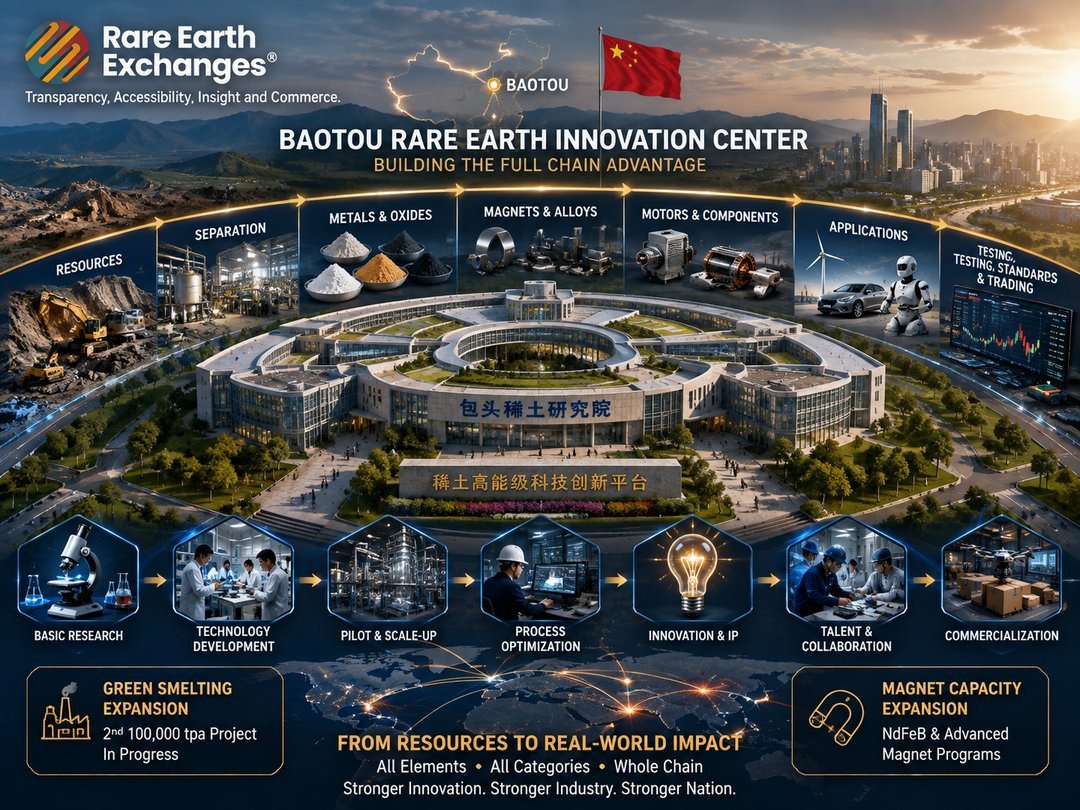
- Baogang Group broke ground on a 127,000-square-meter rare earth science and technology innovation platform in Baotou on August 30.
- The project centers on upgrading the Baotou Research Institute of Rare Earths to strengthen R&D, tech transfer, and commercialization across all rare earth categories.
- Baotou's 2026 agenda includes full-element development, a second 100,000-ton-class green smelting project, and expanded magnet capacity.
- China's rare earth advantage extends beyond mining and separation to feedback loops between researchers, processors, equipment suppliers, and customers.
- No capex figure, completion date, or specific technology milestone was disclosed, making this strategic capacity-building rather than a production breakthrough.
China is not simply defending its rare earth lead—it is building infrastructure designed to extend it. On August 30, state-owned Baogang Group broke ground on a 127,000-square-meter rare earth science and technology innovation platform centered on a major upgrade of the Baotou Research Institute of Rare Earths. The stated goal is unusually broad: strengthen research, technology development, and commercialization across all rare earth elements, product categories, and supply-chain stages. No technological breakthrough was announced. The business significance is China’s continued investment in the institutional machinery that turns rare earth resources into industrial know-how.
REEx Insight: China Is Building a Moat Around the Moat
Investors often describe China’s advantage as dominance in mining and separation. That understates it. Baotou is assembling a dense industrial ecosystem: resources, separation, metals, magnets, motors, application development, laboratories, testing, standards, talent, and increasingly trading infrastructure. Baotou’s official 2026 agenda calls for expanded full-element and full-category development, a second 100,000-ton-class green smelting project, and new magnet capacity. Its longer-term plan explicitly targets permanent-magnet motors, robotics, EV motors, wind generation, high-purity metals, and other downstream applications. The city’s rare earth exchange now reports trading coverage across 63 product categories, from oxides and metals through NdFeB magnets.
That is the deeper Western problem. The U.S. and Europe can finance mines, separators, and magnet plants, but China’s advantage includes feedback loops between researchers, equipment suppliers, processors, and customers. Those capabilities take years to reproduce. In Great Powers Era 2.0™, the contest is shifting from who owns the ore to who owns the knowledge, process control, and industrial learning curve.
So in a nutshell, Western comparisons based only on announced tonnes of mine, separation, or magnet capacity are incomplete. China is also investing in the institutional layer that improves yields, develops new applications, trains engineers, solves plant problems, and shortens commercialization cycles. That layer does not appear on a conventional capacity chart—but it may be one of China's hardest advantages to replicate.
From Ore to Applications
Baogang says the project will systematically modernize existing research infrastructure, improve technology-transfer capability, and create a shared research community. That language matches Baotou’s formal strategy to transform its resource advantage into industrial and strategic advantage and become China’s largest rare earth new-materials base and a globally leading applications center.
The key caveat: no capex figure, completion date, specific technology milestone, or commercial output target was disclosed. Investors should therefore view this as strategic capacity-building, not evidence of a new production breakthrough.
REEx Connect
| Organization / Person | Strategic Role |
|---|---|
| Baogang Group | State-owned project sponsor and industrial parent |
| China Northern Rare Earth | Major Baogang rare earth subsidiary |
| Baotou Research Institute of Rare Earths | Research institution receiving the infrastructure upgrade |
| Meng Fanying | Baogang Chairman and Party Secretary |
| Li Xiao | Baogang General Manager |
| Liu Peixun | China Northern Rare Earth Chairman |
| Baotou Municipal Government | Local industrial-policy authority |
| Baotou Rare Earth High-Tech Zone | Core regional rare earth industrial cluster |
Source disclaimer: This news originates from media operated by a Chinese state-owned enterprise. Project descriptions, objectives, and strategic claims should be independently verified where possible.


0 Comments
No replies yet
Loading new replies...
Moderator
Join the full discussion at the Rare Earth Exchanges Forum →