
Highlights
- China Northern Rare Earth hosted Inner Mongolia University researchers to discuss rare-earth solid-state hydrogen storage commercialization and technical bottlenecks.
- Lanthanum-based alloys capable of absorbing and releasing hydrogen could offer alternatives to high-pressure or cryogenic storage, though cost and performance barriers remain.
- China's push into hydrogen intersects with its oil-import vulnerability, with three ministries launching hydrogen pilot programs in 2026 to connect production, storage, and end use.
- The collaboration signals China's broader strategy to leverage its rare-earth ecosystem as a platform for advanced materials R&D across future industries.
- No breakthrough was announced; the significance lies in the industrial model connecting university science directly with a major rare-earth producer and existing equipment.
China Northern Rare Earth Group High-Tech [SHA: 600111] hosted researchers from Inner Mongolia University (opens in a new tab) for talks covering rare-earth materials, solid-state hydrogen storage, technology commercialization, and technical training. The delegation, led by Liu Jian (opens in a new tab), dean of the university's School of Chemistry and Chemical Engineering, visited Northern Rare Earth's Xi'ao Ke operation to examine solid-state hydrogen-storage equipment and industrial applications. The two sides discussed technical bottlenecks and ways to move research from the laboratory toward commercial use.
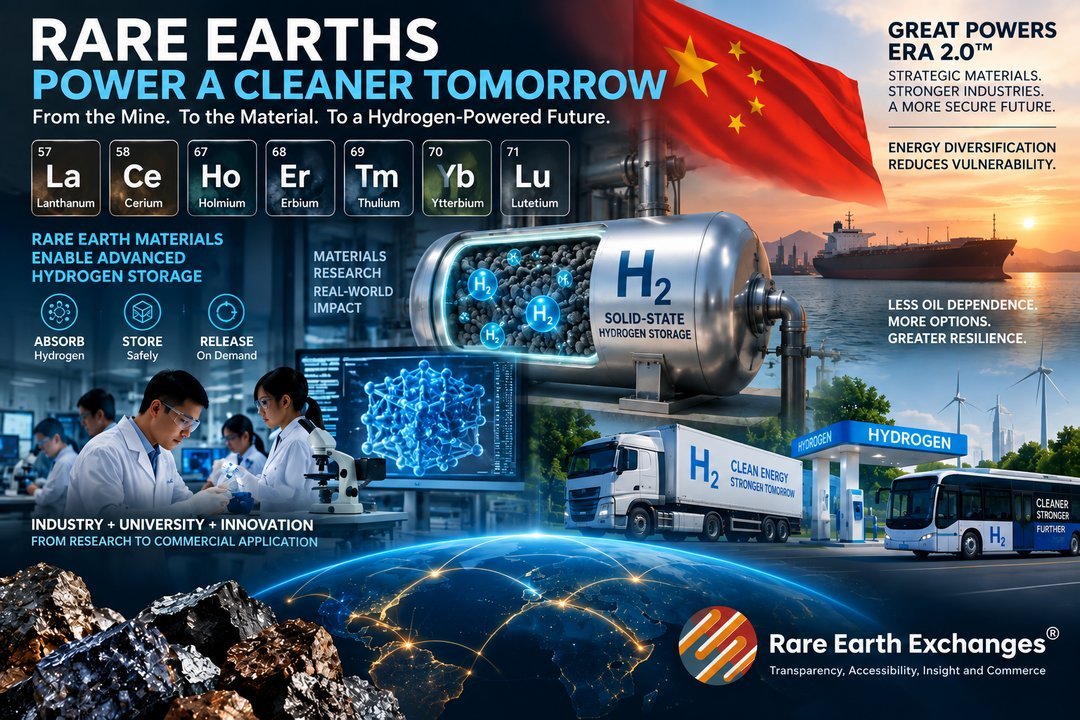
REEx Insight — Rare Earths Become an Energy Tool in Great Powers Era 2.0™
This small research meeting fits into a much larger story. In what REEx calls Great Powers Era 2.0™, China is trying to turn control over strategic materials into advantages farther downstream. Rare earths are not valuable merely because China mines and separates them. Their greater strategic value comes when Chinese researchers turn them into magnets, motors, catalysts, electronics—and potentially hydrogen-storage systems.
Hydrogen also intersects with a Chinese vulnerability: oil imports. China remains the world's largest crude importer. In 2024 it imported about 11.1 million barrels per day, while producing roughly 4.3 million b/d domestically. Most imported crude arrives by sea. That exposes China to prices, sanctions, shipping disruptions, and geopolitical chokepoints such as the unfolding situations in Venezuela and Iran as REEx has reported.
Hydrogen will not eliminate that dependence. But Beijing is actively promoting hydrogen across transportation and industry as one part of a broader energy-diversification strategy. In 2026, three Chinese ministries launched hydrogen pilot programs designed to connect production, storage, transportation, and end use and overcome commercialization bottlenecks.
This is where rare earths become especially interesting. Certain alloys containing lanthanum and other rare earths can absorb hydrogen and later release it. Solid-state storage can avoid some problems associated with extremely high-pressure gas or cryogenic liquid hydrogen, although cost, weight, heat management, and cycling performance remain major barriers. Northern Rare Earth also produces enormous quantities of light rare earths. Developing new uses for those elements can turn potential oversupply into downstream demand.
For the West, that is the larger signal: China is not standing still at the mine or separation plant. It is using its rare-earth ecosystem as a platform for materials-science R&D across multiple future industries.
From Laboratory to Factory
The Inner Mongolia University delegation included Liu Jian, Vice Dean Chu Haibin, and specialists in hydrogen energy and advanced materials. Researchers toured the Baotou Rare Earth Museum before visiting Northern Rare Earth's Xi'ao Ke facilities, where they inspected solid-state hydrogen-storage equipment and discussed industrial applications with company engineers.
Talks covered rare-earth materials, commercialization of research, joint development of technical talent, and cooperation on difficult technologies.
Liu Jian, dean of the University of Inner Mongolia, School of Chemistry and Chemical Engineering

No new hydrogen-storage material, performance record, production target, or commercial order was disclosed. This is not a breakthrough announcement. Its importance is the industrial model: university science being connected directly with a major rare-earth producer and existing equipment.
REEx Connect
| Organization | Key Contact | Strategic Role |
|---|---|---|
| China Northern Rare Earth [SHA: 600111] | Company leadership | Rare-earth materials and commercialization |
| Inner Mongolia University | Liu Jian | Dean, Chemistry & Chemical Engineering |
| Inner Mongolia University | Chu Haibin | Vice Dean |
| Northern Rare Earth Xi'ao Ke | R&D team | Solid-state hydrogen-storage equipment |
| Baotou Rare Earth Museum | — | Rare-earth industry knowledge center |
Source Disclaimer: This news item originates from media associated with China Northern Rare Earth, a Chinese state-controlled enterprise. Technical, commercialization, and performance claims should be independently verified before being relied upon for investment or commercial decisions.


0 Comments
No replies yet
Loading new replies...
Moderator
Join the full discussion at the Rare Earth Exchanges Forum →