
Highlights
- China Northern Rare Earth certified 3,259 employees across 42 occupations and five skill levels, with participation up 83.8% year over year.
- The 2026–2028 Skilled Workforce Quality Improvement Plan combines four major initiatives and 11 measures to shift workforce growth from quantity to quality.
- Western rare-earth policy focused on mines and processing plants risks producing capacity on paper without the trained workforce needed for reliable output.
- China's industrial learning system links universities, occupational standards, apprenticeships and factory-floor experience into a self-reinforcing cycle of expertise.
China Northern Rare Earth (Group) High-Tech Co., Ltd. has conducted its 2026 vocational skills certification examinations for more than 3,259 employees across 21 affiliated units, covering 42 occupations and five skill levels. Employee participation increased 83.8% year over year, according to the company report. The scale matters. China is not treating rare-earth dominance merely as a question of mines, separation plants or capital expenditure. It is systematically building the human infrastructure required to operate, troubleshoot and continuously improve an industrial ecosystem. The examinations included computer-based theory testing and hands-on practical assessments across nine testing sites and 106 examination sessions.
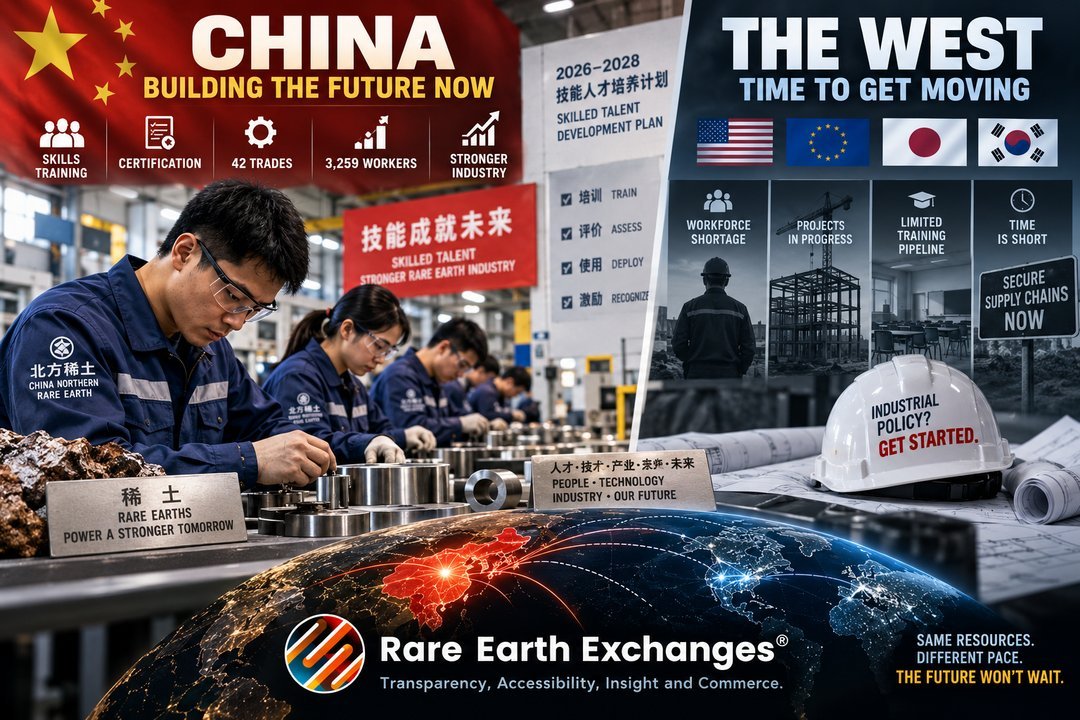
REEx Insight — The West Wants Factories. China Is Building Industrial Memory.
Here lies an uncomfortable irony for Washington and Europe. Rare Earth Exchanges® has repeatedly argued that Western rare-earth industrial policy cannot stop at grants, tax credits, mines and processing plant loans. The West also needs metallurgists, separation specialists, furnace operators, magnet-production technicians, maintenance personnel, process engineers and skilled tradespeople capable of turning new capacity into reliable commercial production. China appears to understand this distinction exceptionally well. Northern Rare Earth is institutionalizing knowledge through certification, standardized occupations, apprenticeships, training and career progression.
Its 2026–2028 Skilled Workforce Quality Improvement Special Training Plan combines four major initiatives with 11 measures intended to move its workforce from growth in “quantity” to a leap in “quality.” This follows earlier work developing occupational standards for rare-earth smelting and materials production. Northern Rare Earth's own reporting says these efforts are intended to fill gaps in China's national vocational standards. That is industrial policy at the factory-floor level.
The strategic implication for the United States is straightforward: a billion-dollar separation or magnet facility without a trained workforce is capacity on paper, not necessarily qualified output. China's advantage increasingly resembles a self-reinforcing industrial learning system—universities feed factories, experienced workers train newer workers, occupational standards codify knowledge, and production generates another cycle of process expertise. China is even developing university-level rare-earth talent pipelines around Baotou.
For Western policymakers, workforce development should therefore be treated as critical-minerals infrastructure, alongside mines, separation, metallization and magnets.
From Classroom to Production Floor
The certification covered junior, intermediate and senior workers, technicians and senior technicians. Candidates were evaluated on theoretical knowledge, operating procedures and practical workplace capabilities. The company says the program was conducted under China's national vocational skills standards with guidance from the Baotou Public Training Center for Highly Skilled Talent.
Northern Rare Earth ultimately wants a workforce that is technically proficient, theoretically grounded and capable of continuous innovation—explicitly linking human-capital development to its ambition to become a “world-class rare-earth leader.” The initiative also appears broader than a one-off examination. In 2025, Northern Rare Earth reported vocational assessments involving more than 1,300 workers from 16 subsidiaries and 42 occupations, meaning the 2026 program represents a significant expansion.
REEx Connect
| Organization | Key Contact / Leadership | Relevance |
|---|---|---|
| China Northern Rare Earth (Group) High-Tech Co., Ltd. | Liu Peixun, Chairman; Qu Yedong, General Manager | Rare-earth mining, separation, metals/materials and workforce development |
| Baotou Steel (Group) | Liu Peixun, Deputy General Manager | Parent industrial ecosystem associated with Northern Rare Earth |
| Baotou Public Training Center for Highly Skilled Talent | Institutional leadership | Guided implementation of the 2026 skills examinations |
| Baotou Municipal Human Resources and Social Security Bureau | Li Shaoqiang, Director | Rare-earth occupational standards and skilled-workforce development |
| Nonferrous Metals Industry Skills Appraisal and Guidance Center | Institutional leadership | Occupational standards and skills certification |
| Inner Mongolia University of Science and Technology | University leadership / rare-earth faculty | Rare-earth and minerals education feeding Baotou's industrial workforce |
Source disclaimer: This news item originates from media associated with a Chinese state-owned enterprise. Corporate claims, participation figures and reported outcomes should be independently verified before being relied upon for investment, commercial or policy decisions. Where available, REEx reviewed additional corporate filings and outside reporting for context.


0 Comments
No replies yet
Loading new replies...
Moderator
Join the full discussion at the Rare Earth Exchanges Forum →