
Highlights
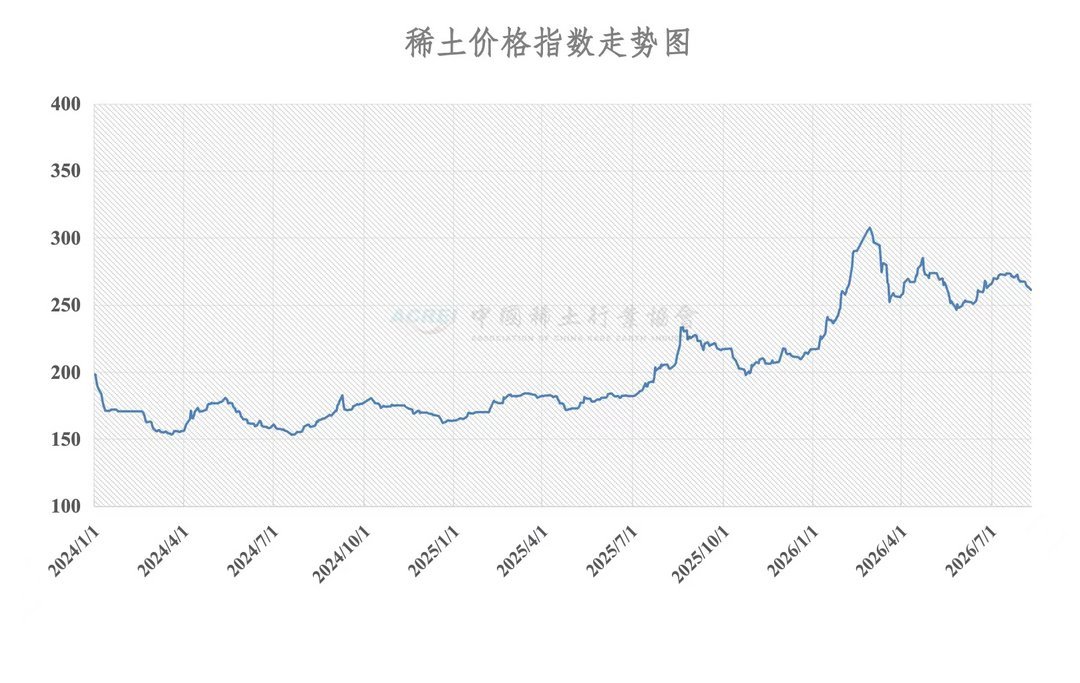
- China's Rare Earth Price Index dropped to 261.1 from 268.4, with NdPr oxide at $107–110/kg and terbium oxide at $990–999/kg domestically.
- Ex-China prices for dysprosium oxide range $575–2,500+/kg and terbium oxide $2,050–5,000+/kg, reflecting severe supply scarcity outside Chinese markets.
- China controls over 90% of rare earth processing, making ex-China price discovery immature, bilateral, and largely confidential.
- Contractual floors like the Pentagon's $110/kg NdPr deal with MP Materials are bespoke agreements, not universal global benchmarks.
- For heavy rare earths like dysprosium, terbium, and yttrium, availability and qualification can matter more than any published price index.
China's Rare Earth Industry Association reported its Rare Earth Price Index at 261.1 on August 10, 2026, down from 268.4 on July 29. The accompanying price sheet shows NdPr oxide at ¥716.3–736.3/kg (US$107.45–110.45), dysprosium oxide at ¥1,365–1,405 (US$204.75–210.75), and terbium oxide at ¥6,600–6,660 (US$990–999), using ¥1 = US$0.15. Those numbers look precise. The market behind them is anything but.
REEx Insight | There Is No Single “Rare Earth Price”
China's quotations are useful domestic reference points—not global free-market prices. Production controls, state-owned enterprises, export licensing, and industrial-security policy all influence China's rare-earth ecosystem.
Ex-China pricing is arguably even harder to pin down. Transactions are thin, bilateral, specification-dependent, and usually confidential. China still controls more than 90% of rare-earth processing, underscoring how immature alternative price discovery remains.
August 10: China Versus the Market Outside China
| Strategic product | China ¥/kg | China US$/kg* | Indicative ex-China US$/kg |
|---|---|---|---|
| NdPr oxide | ¥716.3–736.3 | $107–110 | $120–140 |
| NdPr alloy | ¥874.9–894.9 | $131–134 | $150–185 |
| Dysprosium oxide | ¥1,365–1,405 | $205–211 | $575–2,500+ |
| Terbium oxide | ¥6,600–6,660 | $990–999 | $2,050–5,000+ |
| Yttrium oxide | ¥58.7–62.7 | $8.81–9.41 | No reliable broad spot range; availability can dominate price |
| Holmium oxide | ¥584.6–604.6 | $87.69–90.69 | Thin/bespoke; insufficient transparent transactions for a defensible range |
*China dollar conversion uses the requested ¥1 = US$0.15. Ex-China ranges are indicative REEx assessments, not exchange-traded prices. REEx previously estimated $575–2,500+ for Dy oxide and $2,050–5,000+ for Tb oxide, emphasizing that scarcity can push individual transactions substantially outside published assessments.
When “Price” Stops Meaning Much
The contrast is striking. USA Rare Earth's Serra Verde materials cite current non-China indications around $1,100/kg Dy and $4,000/kg Tb, while its 15-year offtake contains floors of $575 Dy and $2,050 Tb. Those floors are contractual structures—not universal market benchmarks.
Likewise, the Pentagon's $110/kg NdPr floor applies specifically to MP Materials under its 10-year agreement. It did not decree a $110 global NdPr floor. Yttrium illustrates the extreme: outside China, the question can become not “what does it cost?” but “can you get it?” Outside of rare earths, other critical minerals are going through a similar scenario, such as Germanium.
REEx Bottom Line: Rare earths do not yet have a gold-like global price. For Dy, Tb, and increasingly Y, scarcity, origin, qualification, and contractual terms can matter more than the number printed on yesterday's price sheet.


0 Comments
No replies yet
Loading new replies...
Moderator
Join the full discussion at the Rare Earth Exchanges Forum →