
Highlights
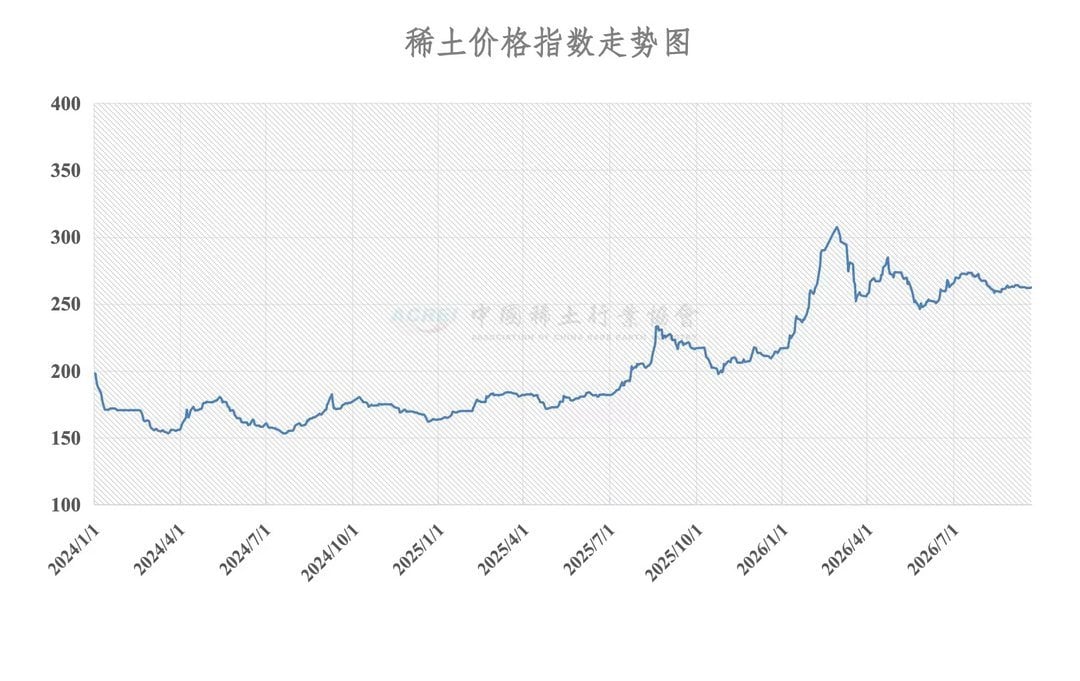
- China's CREIA index reached 262.3 on September 21, 2026, masking a deeply split market between domestic and ex-China heavy rare earth prices.
- Dysprosium oxide trades at $212–218/kg in China but up to $3,250/kg in North America; terbium oxide shows a similar gap from ~$997 to $7,500/kg.
- China controls 85–90% of rare earth refining and nearly all heavy rare earth separation, making export licensing as critical as price for buyers.
- Government price floors like the U.S. NdPr deal with MP Materials are company-specific, not market benchmarks, and should not be treated as universal references.
- For scarce heavy rare earths like yttrium, the key question has shifted from cost to availability, as China shipped none to Japan in June 2026.
The China Rare Earth Industry Association (CREIA) reported a September 21, 2026 Rare Earth Price Index of 262.3, with 2010=100. The headline is remarkably stable—September 17 was 262.0—but the underlying market is fractured. China's sheet shows NdPr oxide rising to ¥720.7–740.7/kg (US$108.11–111.11), while dysprosium oxide fell to ¥1,410–1,450 ($211.50–217.50) and terbium oxide to ¥6,585–6,645 ($987.75–996.75), using REEx's standardized ¥1=US$0.15 conversion.
REEx Insight — A Price Is Not Necessarily a Market
The biggest mistake is treating these numbers like copper or gold prices. China's domestic rare-earth system is shaped by production controls, state-owned producers, export licensing, industrial policy, and national-security priorities. CREIA's references are useful—but they are not unconstrained Western-style price discovery. REEx has repeatedly documented this distinction. We are not referring to markets in the normal sense as understood in the West.
Outside China the opposite problem exists: too little market to be a market as we understand it in the popular sense, although so-called pricing agencies sell expensive reports suggesting they have such insight. China still accounts for about 85% to 90% of global rare-earth refining (98% or so of heavy rare earth separation). Ex-China trades are thin, bilateral, specification-dependent, and usually confidential. Pricing agencies necessarily sample a small market, sometimes relying heavily on traders. Published assessments should therefore be treated as indications at best—not executable prices. September illustrates the danger dramatically: S&P Global reported (opens in a new tab) an actual Dy oxide transaction at $3,250/kg in North America and Tb oxide at $7,500/kg—multiples of today's Chinese references.
The Elements That Matter
| Product | China ¥/kg | China US$/kg | Indicative ex-China US$/kg |
|---|---|---|---|
| NdPr oxide | ¥720.7–740.7 | $108–111 | ~$120–140 |
| Dy oxide | ¥1,410–1,450 | $212–218 | ~$575–3,250+ |
| Tb oxide | ¥6,585–6,645 | $988–997 | ~$2,050–7,500+ |
| Gd oxide | ¥181.6–201.6 | $27–30 | Illiquid/bespoke |
| Ho oxide | ¥631.9–651.9 | $95–98 | Illiquid/bespoke |
| Y oxide | ¥58–62 | $8.70–9.30 | Scarce; sometimes unavailable |
Ex-China figures are indicative observations, contractual floors, or reported transactions—not a universal spot market.
When “Price” Becomes “Can I Get It?”
Heavy rare earths are the warning. China shipped no dysprosium, terbium, or yttrium to Japan in June, illustrating how export permission can overwhelm nominal price. REEx reporting has described Western aerospace suppliers searching for alternatives because yttrium and other controlled materials remain difficult and expensive to source. With yttrium, the commercial question can become “Can you actually get it?” rather than “What does it cost?”
And buyer beware on “floors.” The U.S. government's $110/kg NdPr floor with MP Materials is company-specific, not an American market price. Serra Verde's reported $575/kg Dy and $2,050/kg Tb floors are likewise deal-specific protections—not global benchmarks.
REEx takeaway: rare-earth pricing is becoming a function of element + purity + origin + export permission + qualification + volume + delivery + geopolitical access. For scarce heavies, the cheapest quoted material may be irrelevant if it cannot reach the buyer.
Source Disclaimer: The underlying price data comes from the China Rare Earth Industry Association, not a state-owned enterprise. CREIA operates within China's state-directed rare-earth policy environment and states that its figures are industry-collected references only. Chinese and ex-China pricing should be independently verified before procurement or investment decisions.


0 Comments
No replies yet
Loading new replies...
Moderator
Join the full discussion at the Rare Earth Exchanges Forum →