
Highlights
- China shipped more than 40,000 humanoids in H1 2026, representing 97% of reported global shipments, backed by dominance in NdFeB magnet production.
- Tesla is auditing Chinese suppliers including Sanhua, Joyson, and Tuopu as it prepares to scale Optimus, highlighting America's component dependency.
- MP Materials and USA Rare Earth are building domestic NdFeB capacity, but neither facility begins commissioning until 2028—while China's ecosystem operates at full scale now.
- Morgan Stanley projects over 1 billion humanoids by 2050 and $800 billion in cumulative critical mineral demand, with rare earth magnets as a central input.
- China is deliberately linking robot makers, magnet producers, motor manufacturers, and state institutions into one integrated industrial ecosystem.
The humanoid race is rapidly becoming a test of which industrial ecosystem can convert artificial intelligence into physical scale—and China enters that contest with a formidable materials advantage. Through summer 2026, China pushed humanoids from exhibitions toward factories. A report released by the China Humanoid Robot and Embodied Intelligence Committee of 100 says Chinese producers shipped more than 40,000 humanoids during the first half of 2026, representing 97% of reported global shipments. Those numbers are striking, but they should be treated as Chinese industry estimates: definitions of a “humanoid” and a “shipment” remain fluid in this young market.
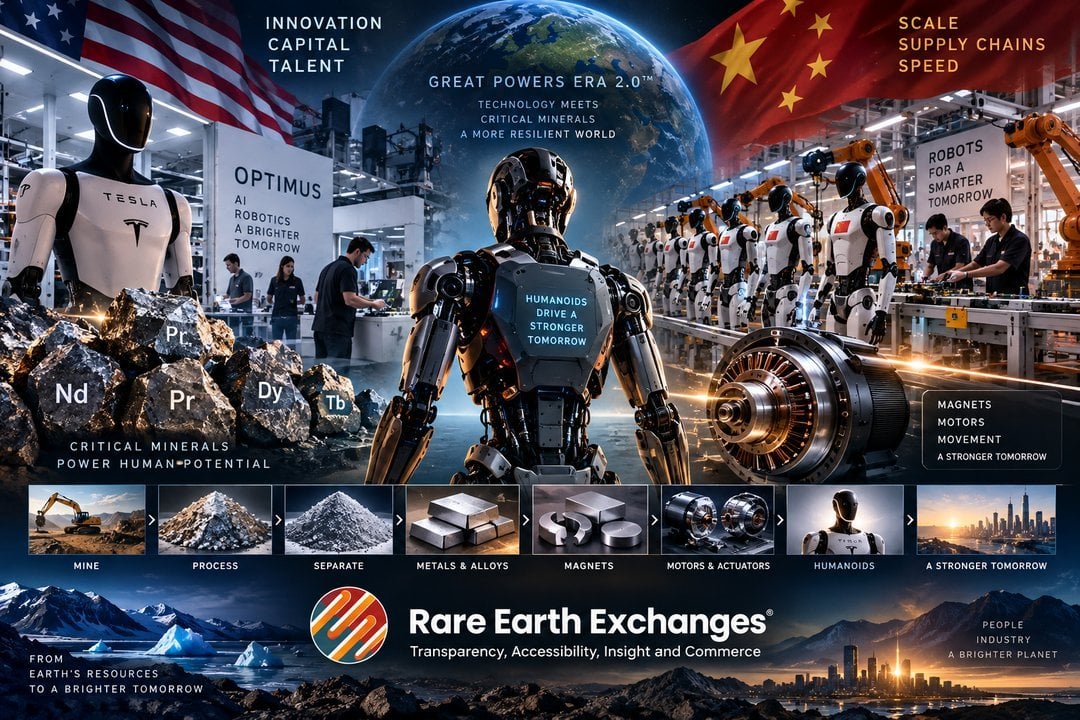
Meanwhile, Tesla [NASDAQ: TSLA] is reportedly auditing Chinese suppliers as it prepares to scale Optimus. The United States retains enormous advantages in AI, software, venture capital/capital markets and companies including Tesla, Figure, Apptronik, and Agility Robotics. But a robot's “muscles”—its compact motors and actuators—often depend on sintered NdFeB permanent magnets. The International Energy Agency estimates China accounted for 91% of magnet-rare-earth refining and 94% of sintered permanent-magnet production in 2024.
REEx Insight: Great Powers Era 2.0™ Gets Legs
Rare Earth Exchanges® has argued throughout 2026 that Great Powers Era 2.0™ is increasingly ecosystem versus ecosystem—not company versus company. China is deliberately connecting robot manufacturers, AI developers, industrial customers, component suppliers, and state-backed institutions. In June, the Ministry of Industry and Information Technology and China's state-assets regulator launched a national program designed to move humanoids and embodied AI into real industrial, service, and specialized operating environments. The government wants more than 100 high-value application scenarios and “ten-thousand-unit-level” deployment capability by year-end.
REEx separately documented China's effort to connect its rare-earth and humanoid industries, including discussions linking permanent-magnet producers, motor manufacturers, actuator developers, and robot assemblers.
That is the strategic distinction: America is scaling robots while simultaneously rebuilding parts of the materials supply chain beneath them. China is scaling robots on top of a materials and manufacturing ecosystem it already dominates.
China Moves From Robot Theater Toward Throughput
Chinese reporting increasingly describes humanoids moving from demonstrations toward what is referred to in Chinese as—“batch delivery.” The 2026 Chinese industry report says more than 40,000 humanoids shipped in H1, representing 97% of reported global shipments. That extraordinary percentage deserves caution rather than dismissal: classification methodologies remain immature, but the direction is consistent with China's broader robotics advantage.
The industrial base underneath it is undeniable.
International Federation of Robotics data show China installed 295,000 industrial robots in 2024—54% of the world's total. Europe represented 16% of global installations and the Americas 9%. China's operational industrial-robot fleet exceeded 2 million units, while Chinese manufacturers supplied 57% of their domestic market for the first time.
REEx's summer coverage tracked the downstream acceleration, including Unitree's IPO and China's robotics push. Unitree ultimately priced an IPO raising approximately RMB6.1 billion—roughly $900 million—at a valuation near $9 billion.
Tesla's China Paradox
Tesla illustrates America's industrial dilemma unusually well. In April, Tesla China President Allan Wang Hao said the Shanghai Gigafactory could provide a “golden key” to humanoid mass production and potentially manufacture robots in the future. Then came September. The South China Morning Post, citing people familiar with the matter, reported that Tesla personnel were auditing parts of its Chinese supply chain as the company prepared to scale Optimus. Potential suppliers included Zhejiang Sanhua Intelligent Controls, Ningbo Joyson Electronic, and Tuopu Group—companies already embedded in Tesla's automotive ecosystem.
But precision matters: Tesla has not announced that Optimus final assembly is moving to China, and some circulating claims about a specific Ningbo audit schedule and 2026 production volumes remain disputed or unconfirmed.
The more defensible conclusion is also more interesting: Tesla appears to be exploring how China's mature component ecosystem can help solve the manufacturing problem of scaling an American-designed humanoid.
America Is Scaling—From a Different Base
The U.S. response is substantial. Figure (opens in a new tab) says its BotQ facility has manufactured more than 350 Figure 03 robots, increased throughput from one robot per day to a demonstrated cycle time of one per hour, produced more than 9,000 actuators, and qualified hundreds of suppliers.
Agility Robotics (opens in a new tab) unveiled Digit 5 in September and reports more than $300 million in multiyear orders. The magnet layer is also finally expanding. MP Materials [NYSE: MP] is developing its 10X Texas campus, which is expected to help bring total company NdFeB capacity to approximately 10,000 tonnes annually, with commissioning beginning in 2028. USA Rare Earth [NASDAQ: USAR] broke ground September 9 on a $1.2 billion South Carolina complex targeting 6,400 tonnes per year of sintered NdFeB magnets and 5,000 tonnes of metal and alloy, also beginning commissioning in 2028. The problem is timing: these projects are ramping or being constructed while China's magnet ecosystem already operates at enormous scale.
The Materials Math Gets Serious at Scale
Humanoids are not simply an AI market. They are machines packed with motors, batteries, copper, electronics, and precision materials. Morgan Stanley models approximately 0.6–1.3 kilograms of NdPr per humanoid, making REEx's previous 1.3-kilogram assumption better described as the upper end of a scenario range, rather than a universal robot bill of materials. Magnet architecture will vary substantially by manufacturer.
Near-term humanoid volumes are unlikely to transform global NdPr demand. Millions—and eventually tens of millions—could.
Morgan Stanley projects more than 1 billion humanoids in service by 2050 and a humanoid market exceeding $5 trillion, with approximately 302 million units potentially operating in China versus roughly 78 million in the United States.
Separately—and importantly—Morgan Stanley estimates humanoids could generate approximately $800 billion in cumulative incremental demand for critical minerals through 2050, spanning rare earths, lithium, nickel, cobalt, graphite, and copper.
REEx has been tracking precisely this convergence in Humanoid Robots Could Drive a New Rare Earth Magnet Demand Wave, China Aligns Rare Earth and Humanoid Robot Supply Chains and Humanoid Robots Outrun Usain Bolt—and Signal the Next Rare-Earth Demand Wave. Those 2050 projections are scenarios, not destiny. Cost, reliability, dexterity, battery life, safety, maintenance, and real-world productivity remain formidable barriers.
REEx Bottom Line
Humanoids may indeed be approaching the Peak of Inflated Expectations. But hype should not obscure the industrial signal.
China increasingly possesses the ability to build the robot, motor, magnet, and much of the chemistry behind the magnet inside one industrial ecosystem. America retains formidable strengths in AI, capital, entrepreneurship, and advanced robotics, while rapidly investing in domestic magnet capacity. That is Great Powers Era 2.0 in miniature: AI may provide the brain. But minerals, magnets, motors, and manufacturing ultimately determine how many brains can walk off the production line.
Citations
International Energy Agency — Rare Earth Elements (opens in a new tab) · International Federation of Robotics — World Robotics 2025 (opens in a new tab) · China MIIT/SASAC — 2026 Humanoid and Embodied Intelligence Initiative (opens in a new tab) · People's Daily — China H1 2026 Humanoid Shipments (opens in a new tab) · Morgan Stanley — Humanoids: A $5 Trillion Market (opens in a new tab) · Morgan Stanley — Embodied AI and Critical Minerals (opens in a new tab) · Figure — Ramping Figure 03 Production (opens in a new tab) · MP Materials — 10X Magnet Campus (opens in a new tab) · USA Rare Earth — South Carolina Magnet Facility (opens in a new tab) · SCMP — Tesla Auditing Chinese Optimus Suppliers (opens in a new tab) · REEx — China Aligns Rare Earth and Humanoid Robot Supply Chains · REEx — Humanoid Robots Could Drive a New Rare Earth Magnet Demand Wave · REEx — Humanoid Robots Outrun Usain Bolt


0 Comments
No replies yet
Loading new replies...
Moderator
Join the full discussion at the Rare Earth Exchanges Forum →