
Highlights
- Trump's August 26 executive order restricts foreign bulk-power equipment including transformers, inverters, and control systems, citing security risks.
- China controls roughly 60% of global transformer production capacity, while over 80% of large U.S. transformers are imported from foreign sources.
- The order may serve as diplomatic leverage ahead of a tentative September 24 Xi Jinping U.S. visit, with rare earth access hanging in the balance.
- Beijing retains overwhelming leverage in heavy rare earths, magnets, and graphite, giving China retaliatory options if negotiations break down.
- U.S. transformer lead times already exceed two years, meaning aggressive foreign supply restrictions could bottleneck AI, defense, and reindustrialization goals.
Washington has opened another front (opens in a new tab) in its strategic contest with China—this time around the machinery carrying America's electricity. President Donald Trump's August 26 order authorizes restrictions on foreign-produced bulk-power equipment presenting unacceptable security risks, including transformers, inverters, battery systems, generators, control systems, firmware, and remote-access capabilities. It is not a blanket China ban; the Department of Energy must identify covered entities, equipment, and implementation rules.
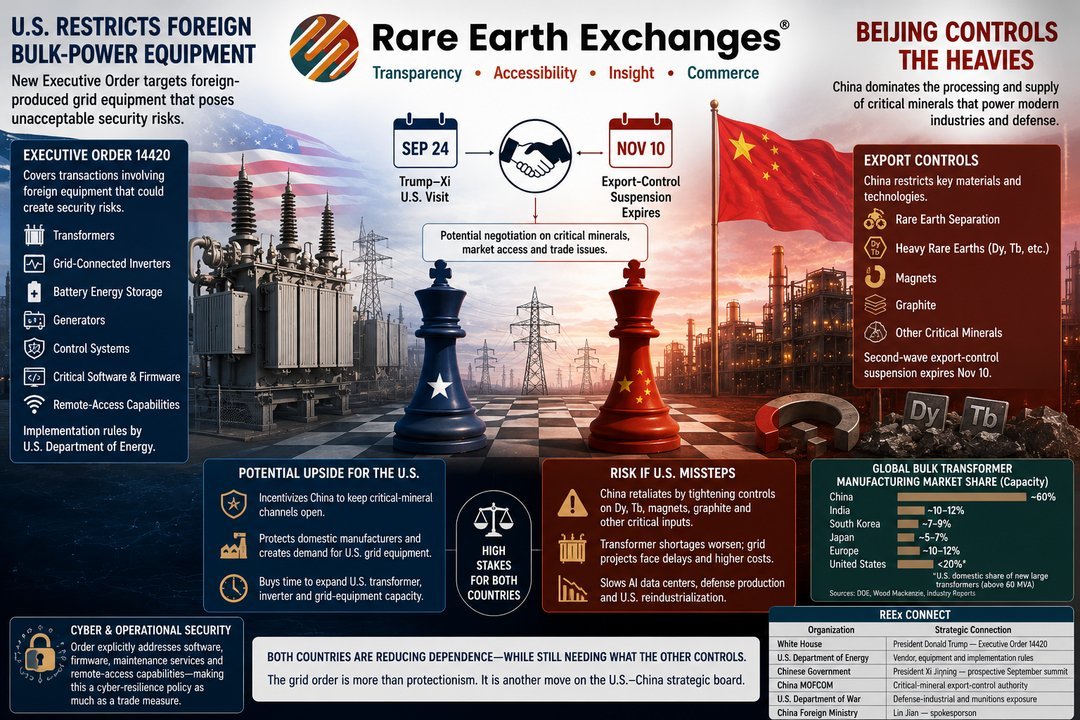
REEx Insight: Trump Adds a Bargaining Chip—but Beijing Still Holds the Heavies
Viewed through Rare Earth Exchanges® (REEx) modeling, this order may be simultaneously defensive industrial policy and bargaining leverage. Washington enters the coming negotiations with an uncomfortable hand. China retains overwhelming leverage across rare-earth separation, heavy rare earths, and magnets. Its broader second-wave export-control suspension expires November 10, while existing controls continue to constrain sensitive materials. Meanwhile, U.S. precision-guided munition inventories have been badly depleted, making access to magnet and critical-mineral supply chains strategically urgent.
Now Washington creates reciprocal vulnerability: access to the world's largest high-value electricity market increasingly depends on being considered a trusted supplier.
That could strengthen Trump's hand ahead of Xi Jinping's tentatively planned September 24 U.S. visit. Washington can potentially trade regulatory flexibility, vendor qualification, or market access against Chinese concessions on rare earths, critical minerals, and other strategic trade issues. We cannot establish that this is Trump's intent. But recent behavior provides an intriguing parallel: Reuters reports the administration has delayed potentially disruptive sanctions against Chinese institutions involved with Iranian oil ahead of the summit.
The game has two outcomes.
If Washington wins: China gains incentive to keep critical-mineral channels open, while U.S. manufacturers receive protected demand and time to expand transformer, inverter, and grid-equipment capacity.
If Washington miscalculates: Beijing can retaliate where American vulnerability is greater—Dy, Tb, magnets, graphite, and other critical inputs—while U.S. restrictions aggravate transformer shortages and slow AI data centers, defense factories, and reindustrialization.
That asymmetry matters. America can eventually manufacture more grid equipment. It cannot manufacture an independent heavy-rare-earth ecosystem by November.
Beijing Sees Containment, Not Cybersecurity
China's Foreign Ministry says Washington is overstretching national security and discriminating against foreign companies. Chinese industry reporting also emphasizes that direct U.S. exposure among many manufacturers is limited.
Washington's concern is broader: the order explicitly covers software, firmware, maintenance services, and remote-access capability, making this as much a cyber-resilience policy as a trade measure.
The strategic danger is therefore deliciously uncomfortable: both countries are trying to reduce dependence while still needing what the other controls. That makes the grid order more than protectionism. It may be another piece moving onto the Trump-Xi chessboard.
The Sector
For large power transformers (LPTs)—the equipment most relevant to the new bulk-power order—the manufacturing imbalance is substantial. China is the clear global leader, with roughly 60% of worldwide transformer production capacity, supported by an unusually complete domestic supply chain spanning electrical steel, copper, and aluminum through cores, tap changers, and finished transformers. Other important manufacturing centers include South Korea, Japan, India, and Europe, while the United States retains domestic production but is heavily import-dependent.
The best authoritative DOE benchmark shows that more than 80% of new U.S. transformers above 60 MVA were imported, implying domestic manufacturers supplied less than 20% of U.S. new-unit demand in that dataset; an earlier DOE analysis put domestic production at about 15% by transformer capacity (MVA) versus 85% imported. This distinction matters: the U.S. is not dependent primarily on China—Chinese equipment reportedly represents only a small portion of the U.S. transformer market—but it is profoundly dependent on foreign manufacturing overall.
Thus, restricting Chinese or other high-risk equipment may be manageable in isolation; aggressively restricting foreign supply more broadly would be much more dangerous. With transformer lead times already exceeding two years and U.S. electricity demand accelerating from AI, manufacturing, and electrification, Washington must expand domestic and trusted-allied capacity rapidly or risk turning a legitimate security policy into another bottleneck for American reindustrialization.
REEx Connect
| Organization | Strategic Connection |
|---|---|
| White House | President Donald Trump — Executive Order 14420 |
| U.S. Department of Energy | Vendor, equipment, and implementation rules |
| Chinese Government | President Xi Jinping — prospective September summit |
| China MOFCOM | Critical-mineral export-control authority |
| U.S. Department of War | Defense-industrial and munitions exposure |
| China Foreign Ministry | Lin Jian — spokesperson |


0 Comments
No replies yet
Loading new replies...
Moderator
Join the full discussion at the Rare Earth Exchanges Forum →