
Highlights
- China became a net exporter of industrial robots in 2025, with exports rising 48.7%, marking a consequential shift from follower to leader in global manufacturing automation.
- Industrial robot proliferation drives demand for neodymium-praseodymium (NdPr) magnets, linking China's robotics expansion to its rare earth supply chain dominance across materials and manufacturing.
- Chinese manufacturers are capturing emerging markets through competitive pricing, rapid delivery, and integrated systems, while the U.S. response remains fragmented compared to China's sustained industrial strategy.
Something subtle—but consequential—has shifted in global manufacturing. In 2025, China’s industrial robot exports rose 48.7%, surpassing imports for the first time and making the country a net exporter of industrial robots.
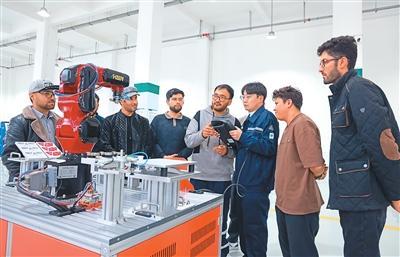
Jinchang City in Gansu Province hosts a professional and technical personnel training program for Afghanistan through the Gansu Vocational and Technical College of Nonferrous Metallurgy. Below, an instructor is explaining industrial robot programming and operation procedures to Afghan trainees at the college's intelligent manufacturing industry-education integration training base.
In official accounts, the moment is framed as a graduation: from follower to peer, and in certain segments, to leader. The explanation is familiar but increasingly hard to dismiss—advances in core technologies, a deeply integrated domestic supply chain, and sustained policy support.
More Than Machines
This is not simply a robotics story. It is also a materials story.
Industrial robots—multi-joint arms, collaborative systems, and emerging AI-enabled platforms—depend heavily on neodymium-praseodymium (NdPr) magnets, a cornerstone of rare earth demand.
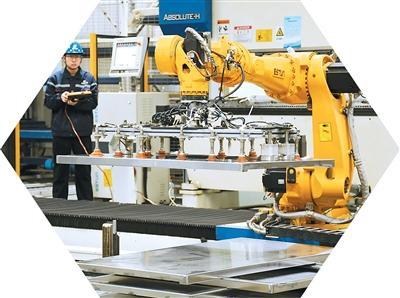
Workers are operating industrial robots at Hebei Gaojing Electrical Equipment Co., Ltd. in Yongnian District Industrial Park, Handan City, Hebei Province.
While far from the scale envisioned in some Western forecasts—such as Morgan Stanley’s far-reaching humanoid robotics thesis—the direction is consistent: automation is becoming a structural driver of mineral consumption. China’s report is grounded in today’s factory floor, not tomorrow’s humanoid frontier. But it points to the same underlying reality: as robots proliferate, so too does demand for the materials that power them.
The Competitive Formula
Chinese manufacturers are gaining traction in markets like Vietnam, Mexico, and Thailand, where industrial upgrading is accelerating but budgets remain constrained. The appeal, according to the report, lies in a pragmatic formula: competitive pricing, rapid delivery, adaptable engineering, and responsive local service networks.
The offering has evolved as well—from standalone machines to integrated systems combining hardware, software, and after-sales support. Advances in collaborative robots, six-axis systems, and AI integration are now part of the pitch.
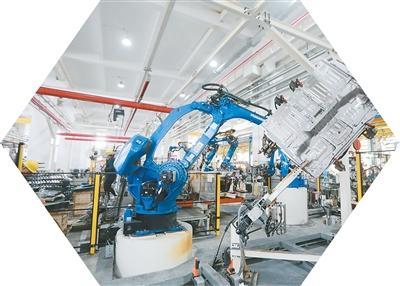
Industrial robots are operating on an intelligent production line at an auto parts manufacturing company in Jiangdu High-tech Industrial Development Zone, Jiangsu Province.
The Deeper Signal
For the United States and Europe, the implications extend beyond trade balances. China is not merely scaling production—it is attempting to shape the next phase of industrialization through research and development, standard-setting, and full-spectrum deployment across dozens of sectors. The report notes adoption across 71 industrial categories, alongside new national standards and government-backed quality initiatives.
There is no single breakthrough here—no moment of sudden disruption. Instead, there is something more consequential: steady, system-wide accumulation of capability.
A Quiet Realignment
If robotics becomes a defining industry in the coming decades, it will not stand apart from the rare-earth supply chain—it will depend on it.
And China, increasingly, is positioning itself to lead across both domains. While the United States has begun to embrace elements of industrial policy—price floors and targeted support among them—the response remains fragmented and modest by comparison. What has yet to emerge is the kind of sustained, integrated strategy—spanning materials, manufacturing, and downstream demand—needed to meaningfully counter China’s accelerating industrial momentum.
Disclaimer: This report draws on an article published by the China Rare Earth Industry Association, citing People’s Daily, both aligned with China’s state information system. The claims should be independently verified.


0 Comments
No replies yet
Loading new replies...
Moderator
Join the full discussion at the Rare Earth Exchanges Forum →