
Highlights
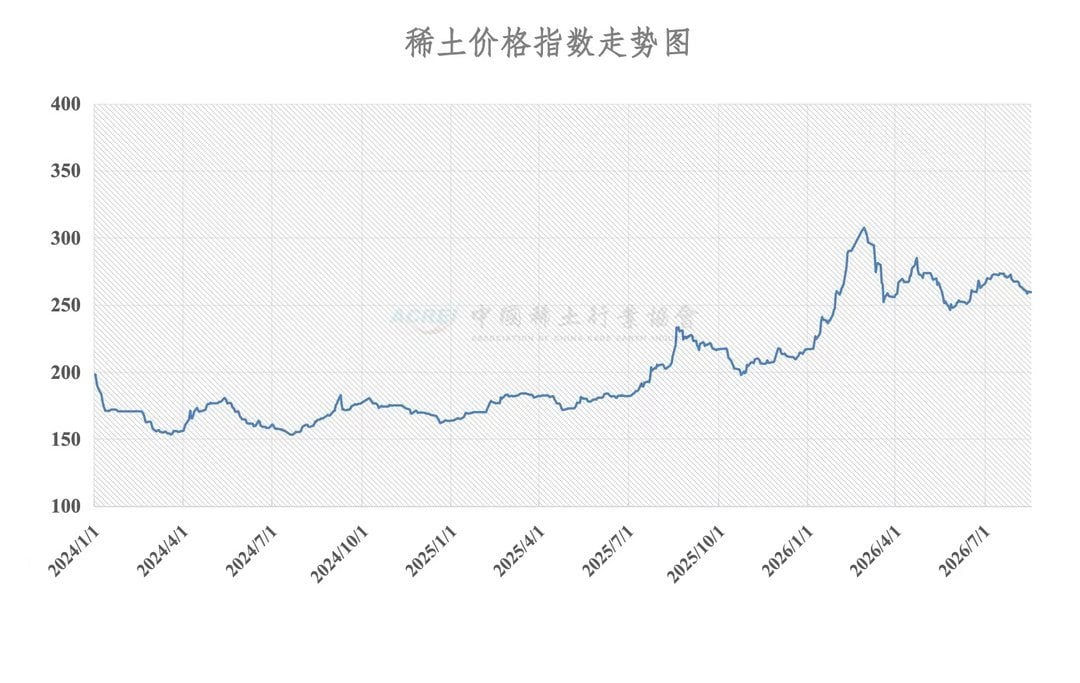
- China's Rare Earth Price Index held at 259.5 on August 17, 2026, roughly 160% above its 2010 baseline, masking a deepening East-West pricing divide.
- Dysprosium and terbium command dramatically higher prices outside China, with terbium assessed at $3,600–$5,000+/kg in stressed Western markets versus ~$989–998/kg domestically.
- The Serra Verde–USA Rare Earth 15-year offtake sets contractual floors of $575/kg for dysprosium and $2,050/kg for terbium—roughly 2× current Chinese reference prices.
- Yttrium, priced at under $10/kg in China, has been reported above $1,200/kg in some ex-China specialty transactions due to export licensing bottlenecks.
- True rare earth price discovery remains broken: China's figures are policy-influenced references, while ex-China trades are bilateral, confidential, and availability-dependent.
China's Rare Earth Price Index registered 259.5 on August 17, 2026, roughly 160% above its 2010 baseline. The China Rare Earth Industry Association (CREIA) calculates the index from average daily transaction data submitted by domestic rare-earth companies. The headline, however, masks a more important reality: China and the West increasingly operate in different rare-earth pricing worlds. China's magnet-critical neodymium-praseodymium (NdPr) oxide stood at ¥711–731/kg ($106.65–$109.65), while dysprosium and terbium softened domestically. Outside China, those heavy rare earth elements can command multiples of Chinese reference prices—or simply become unavailable.
REEx Insight: Price Discovery Is Broken on Both Sides
China's published numbers are useful reference prices, not Western-style free-market price discovery. Production quotas, export licensing, state-owned enterprises, stockpiling, industrial policy, national-security objectives, and Chinese Communist Party directives all influence the market.
But calling the West a free rare-earth market is equally misleading. China still performs roughly 90% of global separation/refining. Ex-China transactions are predominantly over-the-counter, bilateral, confidential, and bespoke, incorporating purity, qualification, volume, delivery, and geopolitical risk.
Pricing agencies therefore often work from thin samples of traders and market participants. REEx cautions corporate buyers: a published assessment is a snapshot, not necessarily “the price.”
The Strategic Metals That Matter Most
| Critical Product | China ¥/kg | China US$/kg* | Indicative Ex-China Context |
|---|---|---|---|
| NdPr oxide | ¥711–731 | $106.65–109.65 | ~$110+; U.S. DoD's $110/kg MP Materials floor is deal-specific, not an industry floor |
| Dysprosium oxide (Dy) | ¥1,365–1,405 | $204.75–210.75 | ~$1,100–$2,000+/kg reported in stressed Western markets; Serra Verde contractual price floor $575. |
| Terbium oxide (Tb) | ¥6,590–6,650 | $988.50–997.50 | ~$4,500–$4,700+/kg reported; availability-dependent==price can double this in some cases. Serra Verde contractual price floor $2,050. |
| Yttrium oxide (Y) | ¥57.8–61.8 | $8.67–9.27 | ~$120–$320+/kg reported for some Western specialty transactions; in some cases north of $1,200 per kg for specialized ex-China spot and tight regional contract markets, driven by export licensing bottlenecks and geopolitical supply restriction. |
*Using REEx's requested conversion of ¥1 = US$0.15. Ex-China ranges are indicative—not exchange-traded spot benchmarks—and may vary dramatically by purity, quantity, jurisdiction, and delivery.
Heavy Rare Earths: Sometimes Price Isn't the Question
REEx has documented dysprosium, terbium, and yttrium transactions at multiples of Chinese domestic references. In extreme circumstances, the buyer's problem is not what yttrium costs—it is whether qualified material can be procured at all. (rareearthexchanges.com)
Public deals illustrate the emerging strategic-market structure. The U.S. Department of Defense established a $110/kg NdPr floor specifically for MP Materials, while the Serra Verde–USA Rare Earth arrangement disclosed floors around $575/kg for dysprosium and $2,050/kg for terbium. Neither should be extrapolated across the industry. (rareearthexchanges.com) Buyer beware: rare earths increasingly have prices—but not yet a true global price.
REEx Connect: Key Ex-China Terbium Deal Terms
The Serra Verde arrangement is currently the most useful publicly disclosed ex-China terbium benchmark, but it must not be confused with a global spot price. The 15-year agreement covers 100% of Serra Verde's Phase 1 production through a U.S.-capitalized special-purpose vehicle (SPV), with guaranteed minimum floors for Nd, Pr, Dy, and Tb.
| Key Category | Description / Deal Term | Potential Impact on Terbium Price |
|---|---|---|
| Terbium floor | US$2,050/kg Tb reported minimum contractual price. | Establishes a highly visible economic support level for this particular Western supply chain, but not an industry-wide floor or spot price. |
| Contract duration | 15-year offtake agreement. | Reduces producer exposure to Chinese price suppression and supports financing of long-lived ex-China capacity. Could encourage higher structural Western contract pricing. |
| Volume commitment | Agreement covers 100% of Serra Verde Phase 1 production, rather than occasional spot purchases. | Removes meaningful ex-China HREE supply from an already thin open market, potentially supporting scarcity premiums for uncontracted Tb. |
| Government backing | Offtake is with an SPV capitalized by the U.S. government and private sources; Serra Verde separately secured substantial U.S. government financing. | Introduces national-security economics into price formation. Buyers increasingly compete not only with other corporations, but with government-supported supply chains. |
| Price protection + upside | USA Rare Earth describes guaranteed minimum floors with access to shared upside. | The producer gets downside protection without necessarily surrendering all gains if scarcity drives prices higher—a potentially powerful template for future Western contracts. |
| China comparison | China's August 17 Tb oxide reference is about ¥6,590–6,650/kg, or roughly $989–998/kg using $0.15/¥. | The $2,050 contractual floor is roughly 2× the current Chinese reference, illustrating the emerging security-of-supply premium. |
| Stressed ex-China market | REEx has tracked reported/assessed ex-China Tb oxide around $3,625–$4,500+/kg during severe scarcity. | Demonstrates that $2,050 is a floor, not a ceiling. When physical availability collapses, executable prices can potentially rise far above protected producer economics. |
| Strategic scarcity | Serra Verde has been described as the only current scaled producer outside Asia capable of supplying all four magnet rare earths, including Tb. | Concentrated supply gives Tb an unusually large availability premium. Qualification and guaranteed delivery can matter more than nominal published prices. |
| REEx interpretation | The transaction is bespoke, bilateral, and strategically supported. | Do not extrapolate $2,050/kg across the industry. It is evidence of what one strategic contract requires to support ex-China production—not proof that terbium has a universal Western price. |
REEx takeaway: Terbium increasingly has at least three different price concepts: a China domestic reference (~$1,000/kg), a strategic ex-China contractual floor ($2,050/kg in the Serra Verde arrangement), and a potentially much higher scarcity/physical-delivery price, with reported assessments reaching roughly $3,600–$5,000+/kg. The spread itself is the story. In such a thin market, availability, purity, qualification, jurisdiction, delivery certainty, volume, and contract duration may determine the real price more than any published “spot” quotation.
REEx Source Disclaimer: The underlying Chinese pricing data originates from the China Rare Earth Industry Association and is collected from domestic industry participants. CREIA itself describes the figures as reference information. Given China's state-directed rare-earth system, the data should be independently verified and should not be interpreted as globally discovered market prices.


0 Comments
No replies yet
Loading new replies...
Moderator
Join the full discussion at the Rare Earth Exchanges Forum →