
Highlights
- Kachin State's ionic-adsorption deposits supply roughly half of global heavy rare earths, including dysprosium and terbium
- The KIA captured major mining districts in 2024; India subsequently explored sourcing heavy rare earth samples through the rebel group
- DVB journalist warns India's mineral outreach risks 'resource imperialism,' but REEx notes the claim is normative, not an established fact
- China dominates downstream processing but does not fully control the Kachin ground supplying its most critical heavy rare earths
- Transparent Indian purchasing and non-Chinese separation capacity could turn Kachin into a strategic crack in China's rare earth fortress
One of the world's most strategically important mining districts is now controlled largely by rebels, and India wants access. A Democratic Voice of Burma (opens in a new tab) (DVB) opinion piece (opens in a new tab) by journalist Shalini Perumal argues that India's outreach to Myanmar's Kachin Independence Army (KIA) risks turning critical-mineral security into “resource imperialism.” The ethical warning deserves attention. But investors should separate documented supply-chain facts from the author's explicitly normative interpretation.
Kachin State Mine Locations Examples
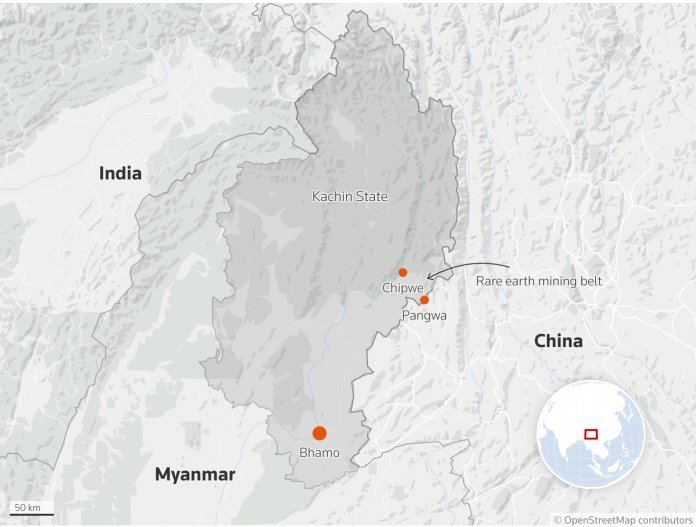
Source: DVB/Reuters
REEx Insight: The World's No. 1 Rebel-Controlled Mining Asset
REEx Insights Rankings places Myanmar Rebels—led by the KIA's Kachin State position—No. 1 globally for rebel-controlled heavy rare-earth upstream mining assets. Note that the mining is done under horrible conditions involving intermittent violence linked to the ongoing civil war, questionable business groups eventually linked to Chinese state rare earth companies in the south, and great ecological destruction.
That REEx Myanmar Rebels #1 ranking reflects an extraordinary geological and geopolitical reality. Kachin's ionic-adsorption deposits supply roughly half of global heavy rare earths, including dysprosium and terbium, while China remains overwhelmingly dominant downstream. Reuters confirms that the KIA captured major mining districts in 2024 and that India subsequently explored obtaining heavy-rare-earth samples through the rebel organization.
REEx notes that the KIA and its sister political organization Kachin Independent Organization (KIO) are predominantly Christian and have been struggling (along with other ethnic groups) for basic human liberties for decades. The violence imposed by the junta (military dictatorship), with at least some backing from both China and Russia, has intensified lately.
All of this goes to create a remarkable inversion of conventional resource power: China dominates processing but does not fully control the ground supplying some of its most strategically valuable heavy rare earths.
DVB correctly emphasizes environmental destruction from poorly regulated leaching and the risks inherent in sourcing minerals from an active conflict zone. But calling India's strategy “neo-colonialism” is interpretation, not established fact. Nor is there evidence presented that Indian mineral engagement itself has financed atrocities. Those distinctions matter.
DVB's Lens: Democracy First, Markets Second
The DVB is an independent, Thailand-registered nonprofit founded in 1992. Its stated mission explicitly promotes democracy, human rights, ethnic diversity, and open political debate. That naturally informs its coverage of Myanmar's junta and ethnic conflicts.
Crucially, however, this article is guest commentary, not DVB editorial policy; DVB expressly says published opinions do not necessarily represent its position. The missing investor question is equally important: if India can develop transparent purchasing, environmental standards, and non-Chinese separation capacity, Kachin could become not merely a conflict-mineral problem—but one of the few conceivable cracks in China's heavy-rare-earth fortress.


0 Comments
No replies yet
Loading new replies...
Moderator
Join the full discussion at the Rare Earth Exchanges Forum →