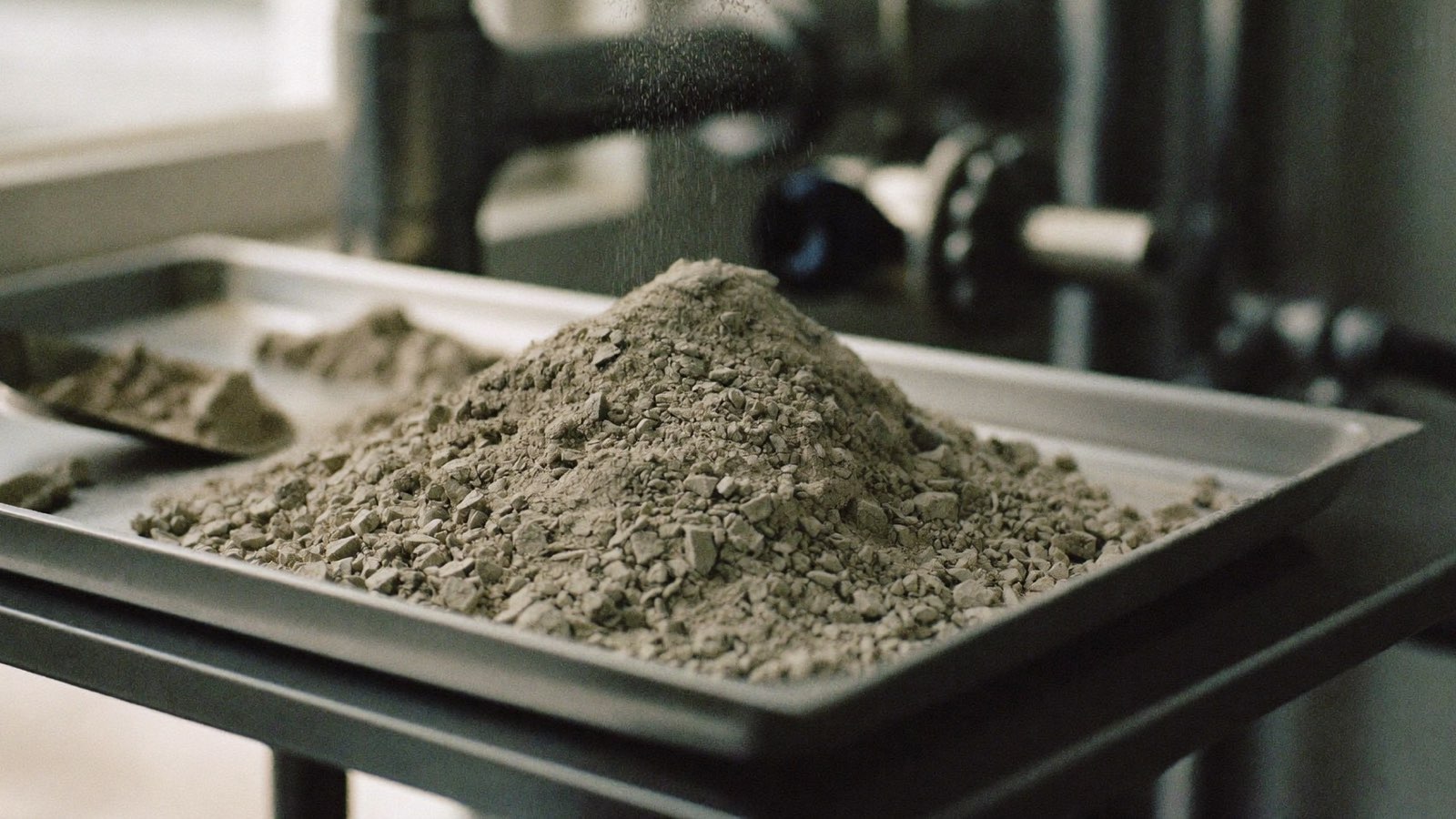
A list of rare earth mining companies is only useful if it tells you which ones actually produce. A company with a promising drill result and a company shipping separated oxide often sit side by side, and nothing on the list says which is which. A buyer who treats a drill result as supply can wait years for oxide that never ships. The companies below are grouped by region. It is not a ranking, and nothing here is a buy list. For the full American roster, see the REEx guide to US rare earth companies.
Table of Contents
What makes a rare earth mining company a producer?
A rare earth mining company becomes a producer when it sells something a manufacturer can use, which in this industry usually means separated oxide. Rare earths come out of the ground mixed together in the same ore. A mine that ships concentrate leaves separation to someone else, and separation is the hardest and most valuable step.
For decades, the companies doing that separation have mostly been in China. The useful question for any company is how far down the chain it reaches on its own: mine, concentrate, separated oxide, metal, magnet. The further it reaches, the more it controls price and customers. A company that has not built its plant is a developer, whatever its press releases call it.
Each step in that chain is a different business with different risks:
- Mining and concentration. Digging ore and upgrading it into a concentrate. Many deposits never reach this stage, because permitting and financing a mine takes years.
- Cracking and separation. Dissolving the concentrate and pulling individual elements apart through long chains of solvent extraction stages. This is the step REEx calls the messy middle.
- Metal and alloy making. Turning oxides such as neodymium and praseodymium into metal for magnet plants.
- Magnet making. Pressing and sintering NdFeB magnets for motors, wind turbines and defense systems. Heavy rare earths like dysprosium and terbium keep those magnets working at high temperatures.
Rare earth mining companies compared
Stage, funding, and offtake terms change every quarter, so the table carries a verification date and a source for each row.
| Company (ticker) | Flagship asset and country | Stage | Funding and offtake status | Key risk |
|---|---|---|---|---|
| Lynas Rare Earths (ASX: LYC) | Mt Weld mine and Kalgoorlie plant, Australia; separation plant in Kuantan, Malaysia | Producing separated NdPr and Dy/Tb oxides. Record 2,082 t NdPr in the September 2026 quarter. Heavy rare earth expansion in Malaysia under construction. | 12-year JARE agreement with firm offtake of 5,000 tpa NdPr at a US$110/kg floor; JARE loan of US$90m outstanding at June 30, 2026. Binding US government letter of intent for about US$96m of oxides over 4 years. Planned Texas heavy rare earth plant will no longer proceed. | Malaysian license condition: plant residue above 1 Bq/g must stop after March 2, 2031. |
| Iluka Resources (ASX: ILU) | Eneabba rare earths refinery, Western Australia | Refinery under construction, 65% complete at September 30, 2026. A$1,237m capex accrued against a A$1.7–1.8bn estimate. First production targeted 2027. | Access to the full A$1.65bn non-recourse Australian government loan confirmed (not fully drawn). Take-or-pay offtake with an unnamed global automaker: 1,200 t of magnet oxides over 4 years from 2028, minimum US$155m. | Cost and schedule; third-party feedstock projects that have not reached FID. |
| Arafura Rare Earths (ASX: ARU) | Nolans project, Northern Territory, Australia | FID announced May 21, 2026. Early site works underway. Not producing. | Funding need of about US$1.9bn. A$350m placement completed. EFA (US$100m) and German Raw Materials Fund (€50m) equity signed, not yet completed. Debt awaiting final credit approvals and contractual close. Binding offtake with a global trading company (the counterparty to the May 2026 Traxys North America term sheet) ramping to 850 tpa NdPr, subject to conditions precedent. | Project finance not yet at contractual close. |
| MP Materials (NYSE: MP) | Mountain Pass mine and separation, California; magnet plants in Fort Worth and Northlake, Texas | Producing: 840 t NdPr oxide in Q2 2026. Magnet manufacturing began December 2025. 10X magnet plant under construction. | Department of War definitive agreements (July 2025): US$400m preferred equity, US$110/kg NdPr price floor through 2035, and purchase of all 10X magnets. US$150m Department of War loan. Apple long-term agreement, performance no earlier than H2 2027. Long-term supply agreement with GM. | Cost or delay at the magnet plants; some market price exposure remains. |
| Energy Fuels (NYSE American: UUUU; TSX: EFR) | White Mesa Mill, Utah; Donald (Australia, joint venture), Vara Mada (Madagascar), Bahia (Brazil) | Has produced separated NdPr at commercial scale; Dy and Tb oxides at pilot scale. No rare earth revenue in H1 2026; uranium is the main revenue source. | Conditional US$725m Office of Strategic Capital loan commitment. US$250m Goldman Sachs term loan commitment letter. VAC magnet merger signed June 23, 2026, not closed. Australian Strategic Materials acquisition completed August 28, 2026. | VAC customer arbitration (begun July 7, 2026); reliance on conditional financing. |
| USA Rare Earth (Nasdaq: USAR) | Stillwater magnet plant, Oklahoma; Round Top deposit, Texas; Serra Verde mine, Brazil; Less Common Metals, UK | Stillwater commissioned; no magnet revenue at June 30, 2026. Round Top at exploration stage. Serra Verde producing. | CHIPS final award of up to US$277m plus a loan of up to US$1.3bn (June 3, 2026), paid in milestone-based phases. Serra Verde output sold to a US-government-backed buyer. | Magnet customer MOUs not yet definitive contracts; negative operating cash flow. |
| Ucore Rare Metals (TSXV: UCU; OTCQX: UURAF) | Louisiana Strategic Metals Complex, Alexandria, Louisiana (US); Bokan-Dotson Ridge, Alaska | Commissioning of the first 600 tpa separation line targeted for H1 2027. RapidSX not yet proven at commercial scale. | US$27.0m cumulative Department of War funding. C$69m equity raise closed August 2026. Vulcan Elements MOU and Sumitomo cooperation framework; neither is a signed offtake. | Scale-up, financing and uncontracted feedstock. |
| NioCorp Developments (Nasdaq: NB) | Elk Creek project, Nebraska | Development stage. Study classed as pre-feasibility in the company 10-K. Upfront capex about US$1.85bn. | EXIM letter of support (October 15, 2026); EXIM board authorization pending. Binding take-or-pay with Traxys for 50% of planned ferroniobium; either party can end it if EXIM approval or financial close has not happened by December 31, 2027. Up to US$10m Department of War reimbursement. | Construction financing not committed. |
| American Rare Earths (ASX: ARR; OTCQX: ARRNF) | Halleck Creek project, Wyoming | Scoping study (September 2026); pre-feasibility study ongoing. No ore reserves declared. | Non-binding EXIM letter, not committed financing. No offtake agreement disclosed. Non-binding Novex MoU for oxide-to-metal work. | US$900m initial capex far exceeds cash; auditor flagged going-concern uncertainty. |
| China Northern Rare Earth (SSE: 600111) | Bayan Obo ore supplied by Baotou Steel, Baotou, Inner Mongolia, China | Produces integrated metals and magnets through separation. | Controlled by state-owned Baogang. One of two groups reported to receive China's mining quotas; quotas are no longer published. | Dependence on related-party ore; state policy. |
| China Rare Earth Group (unlisted; listed arms include SZSE: 000831) | Southern ionic clay and heavy rare earth operations, China | Producing and separating. | Central state-owned group formed in December 2021 under SASAC. The other reported quota holder. | Integration of acquired companies; limited disclosure. |
| Neo Performance Materials (TSX: NEO) | Silmet separation plant, Sillamäe, and magnet plant, Narva, Estonia | Separating rare earths in Estonia. Narva plant in commercial production since September 2026 (Phase 1A nameplate about 2,000 t/y), shipping to a Tier 1 EV motor customer. | Selected for up to €126m from the EU Innovation Fund and invited to prepare a grant agreement. Silmet expansion named an EU Strategic Project. | H1 2026 operating cash outflow of US$49.6m, which Neo tied to inventory, receivables, and a patent settlement; Russian feedstock (REEx reporting). |
| Serra Verde (subsidiary of USA Rare Earth since September 3, 2026) | Pela Ema ionic clay mine, Goiás, Brazil | Producing a mixed rare earth product. Target run-rate of about 4,000 t/y TREO by end of 2026. | DFC loan facility signed at up to US$565m; the tranche of up to US$100m was deemed repaid at the USA Rare Earth closing. 15-year take-or-pay offtake with price floors, sold to a US-government-backed buyer. | The buyer's US$500m bank facility is a commitment letter that lapses December 31, 2026 if not closed; if it is never funded, the buyer may be unable to pay. |
Each company on this page has its own profile in the REEx company directory, alongside the processors and magnet makers that buy from them.
Australia: producers and builders
Australia's rare earth companies sit at very different stages. Government money funds most of Iluka's refinery, and Arafura's project is waiting on government-backed equity and debt.
Lynas Rare Earths (ASX: LYC)
Lynas Rare Earths is the reference point for what a non-Chinese producer looks like. It mines at Mt Weld in Western Australia, processes concentrate at Kalgoorlie and separates oxides in Malaysia, including the heavy rare earths dysprosium and terbium. Japanese partner JARE is both its anchor customer and a lender. REEx covers Lynas's quarterly sales and pricing.
Lynas's biggest risk is its Malaysian license. A license condition sets a deadline to change how the plant handles residue, and the license could be revoked for non-compliance.
Iluka Resources (ASX: ILU)
Iluka Resources is a mineral sands miner. Its Eneabba refinery in Western Australia is designed to turn a large monazite stockpile into separated oxides, including heavy rare earths. Most of the money comes from a non-recourse Australian government loan, which makes Eneabba as much a policy project as a commercial one.
The cost estimate and future feed are its two risks. Part of that feed is meant to come from other companies' mines, so Eneabba depends on projects it does not control. REEx tracks that risk in its Eneabba refinery and heavy rare earth coverage.
Arafura Rare Earths (ASX: ARU)
Arafura Rare Earths owns the Nolans project in the Northern Territory. The project puts a mine and a plant that makes separated NdPr oxide on one site. REEx covered the start of works at Nolans.
Arafura's test is closing its project debt, because its cornerstone equity is expected to complete at that same step. Arafura has also said it will stop naming offtake customers unless the name itself is material. That makes its customer book harder to check from outside.
China: the state-owned groups that set the market
China's rare earth industry has been consolidated into a few state-controlled groups. Beijing allocates annual mining and smelting quotas to designated producers, and these groups are the ones reported to receive them. Beijing no longer publishes those quotas, so Chinese supply is hard to read from outside. Chinese supply also sets the benchmark price that most contracts reference.
China Northern Rare Earth (SSE: 600111)
China Northern Rare Earth processes ore from the Bayan Obo deposit in Inner Mongolia. Its sister company Baotou Steel, under the same state-owned parent, supplies that ore. It covers every step from separation through metals and magnets.
Depending on a related-party ore supplier is China Northern's structural weak point. REEx follows its results and output.
China Rare Earth Group (unlisted)
China Rare Earth Group is a central state-owned group formed from several producers. Its core is the southern ionic clays, historically China's main domestic source of heavy rare earths. The group itself is unlisted but controls listed subsidiaries. It reports little capacity or permit data, a gap REEx flagged in its coverage of the group's integration.
United States: rare earth miners and processors
Most of these US rare earth mining companies have federal money or a federal customer, and each faces a different test:
- MP Materials (NYSE: MP): mines and separates at Mountain Pass, California, and makes magnets in Texas. The Department of War is its shareholder, price guarantor and future magnet buyer, so US policy shapes MP's revenue. Its Fort Worth magnet plant is contracted to supply GM and, later, Apple. Cost or delay at its magnet plants is the open risk.
- Energy Fuels (NYSE American: UUUU): a uranium miner that has separated NdPr at its White Mesa Mill in Utah and is developing mineral sands projects abroad. Its rare earth plan leans on government financing and its VAC magnet deal, so check the status of both before treating the plan as funded.
- USA Rare Earth (Nasdaq: USAR): a magnet plant in Oklahoma, the Round Top deposit in Texas and, through Serra Verde, a producing mine in Brazil. Its test is whether its magnet customer MOUs become binding contracts.
- NioCorp Developments (Nasdaq: NB): the Elk Creek niobium, scandium and rare earth project in Nebraska. Its test is construction financing.
- American Rare Earths (ASX: ARR): the Halleck Creek deposit in Wyoming, an early-stage project. Its estimated build cost is far above its cash, and its auditor has raised doubt that it can keep operating. REEx covered both in Halleck Creek recovery and funding risks.
The full US list, including the separators and magnet makers left out here, is in US rare earth companies: who actually mine, separate, and make magnets.
Canada, Brazil and Europe: separators, magnet makers and a Brazilian mine
Ucore Rare Metals (TSXV: UCU)
Ucore Rare Metals is a Canadian company whose separation plant is in Louisiana. The plant runs on Ucore's own RapidSX solvent extraction technology, and US defense funding has paid for part of the early work. Its Alaska rare earth property is held for later.
Ucore's own risk disclosures say RapidSX may not perform at commercial scale as expected. Feedstock contracts are the other gap. REEx reported on the RapidSX scale-up test.
Neo Performance Materials (TSX: NEO)
Neo Performance Materials runs a rare earth separation plant at Sillamäe in Estonia and a sintered magnet plant at Narva nearby. That puts separation and magnet making under one owner. REEx covered the start of commercial magnet production at Narva.
Its risks are operating cash outflows, which Neo attributes partly to inventory and a patent settlement, and, as REEx has reported, Silmet's reliance on Russian feedstock.
Serra Verde
Serra Verde, owned by USA Rare Earth, operates the Pela Ema ionic clay mine in Goiás, Brazil. The US government backed it with DFC financing as a Western-aligned source of rare earths, including heavy rare earths.
Its output goes to a buyer backed by the US government under a long-term take-or-pay contract with price floors. That contract is only as strong as the buyer's ability to fund it.
How should you judge a rare earth mining company's announcements?
Judge a rare earth mining company by the verbs in its filings, because headlines rarely carry the qualifiers. A "conditional commitment" still needs due diligence and final documents. A "letter of interest" or "letter of support" from a lender is not a loan.
A "final investment decision" means construction can start, while the money may still be waiting on contractual close. "Nameplate capacity" is what a plant was designed to make, which is different from what it produces in a quarter. An MOU or a cooperation framework is usually non-binding, and a take-or-pay offtake is among the strongest customer commitments a developer can show.
Four checks catch most overstatement:
- Is the financing closed or only approved? Find the words "drawn," "closed," or "executed" before treating money as real.
- Is the offtake binding? Look for take-or-pay terms, a named counterparty, and a start date.
- Does the company have its own feedstock? A separator with no contracted feed has a plant with nothing to run through it.
- Who sets the price? A government price floor protects revenue only as long as the policy behind it lasts.
For the elements themselves, start at the rare earth elements hub.
To follow any of these companies between table updates, start from its profile in the REEx company directory.
Frequently asked questions
Who are the biggest rare earth mining companies?
China Northern Rare Earth and China Rare Earth Group are the two state-owned groups reported to hold China's mining quotas. Beijing no longer publishes the quota figures, so their output can't be checked directly. Outside China, the comparison table on this page lists which companies separate rare earth oxides, with a dated status for each.
Which rare earth mining companies produce outside China?
Lynas Rare Earths, MP Materials and Neo Performance Materials separate rare earths outside China. Energy Fuels has produced separated NdPr in Utah, and Serra Verde mines an ionic clay deposit in Brazil. Iluka Resources and Arafura Rare Earths are developing plants in Australia, and the comparison table shows how far each has gotten.
Where are rare earths mined outside China?
Outside China, rare earth ore is mined at Mt Weld in Western Australia, Mountain Pass in California and the Pela Ema ionic clay mine in Brazil, among other sites. Mineral sands operations, such as Iluka's in Australia, also produce monazite, a mineral that carries rare earths. Many more deposits sit at the study stage.
Why is separation harder than mining?
Separation has to split chemically similar elements from one another to high purity, which digging ore never requires. That takes long chains of solvent extraction stages, careful process control and years of tuning before a plant runs to specification. It also produces chemical and radioactive residues that need permits. That is why a mine can run for years while its owner still ships concentrate to someone else for separation.
Why does government funding matter so much for rare earth companies?
Rare earth plants cost hundreds of millions to billions of dollars, and they compete against Chinese supply that sets the benchmark price. Commercial lenders hesitate, so Western governments have stepped in with loans, equity stakes and price floors. That support lowers a project's risk but ties the project to government policy.
Disclaimer: The information provided in this article is for informational purposes only and does not constitute financial, investment, or trading advice. Readers are strongly encouraged to consult with a qualified financial advisor or licensed investment professional before making any trading or investment decisions. Figures change; verify with the issuer before relying on them. Rare Earth Exchanges, LLC makes no representations or warranties as to the accuracy, completeness, or timeliness of the information provided, and shall not be held liable for any losses, damages, or expenses arising from the use of or reliance on this content. All investments carry risk, including the potential loss of principal.