
Highlights
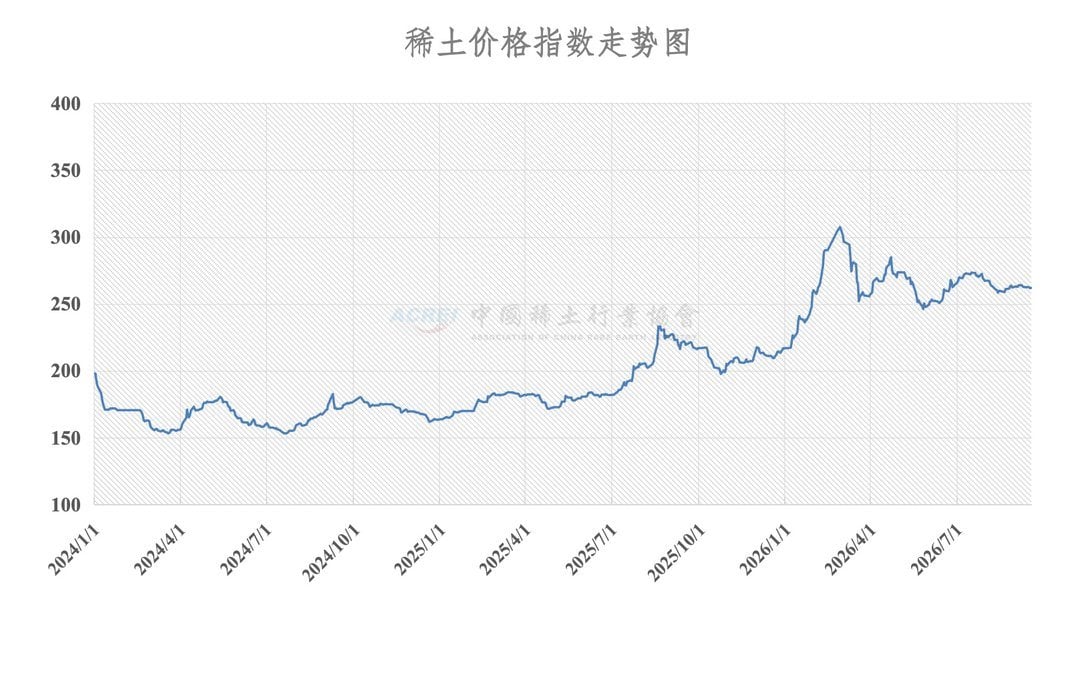
- China's September 17 rare earth price index held flat at 262.0, masking a stark gap between domestic and ex-China heavy rare earth prices.
- Dysprosium oxide trades at $212–218/kg inside China but can reach $575–2,500+/kg for non-Chinese buyers; terbium oxide shows a similar 4–5x premium.
- Export controls, state-owned producers, and opaque OTC transactions mean no single global spot price exists for heavy rare earths.
- USA Rare Earth disclosed indicative non-China values near $1,100/kg for dysprosium and $4,000/kg for terbium, underscoring the scarcity premium.
- Pentagon contract price floors for NdPr and Serra Verde's Dy/Tb floors are contractual minimums, not universal market benchmarks.
China’s Rare Earth Industry Association reported its September 17, 2026 price index at 262.0 (2010=100), essentially flat after 261.8 on September 16. The headline stability conceals the bigger story: China’s domestic dysprosium oxide reference of ¥1,415–1,455/kg ($212–218) and terbium oxide at ¥6,610–6,670/kg ($992–1,001) bear little resemblance to prices Western buyers may encounter for scarce, deliverable non-Chinese material.
REEx Insight — There Is No Single Rare-Earth “Price”
Rare earths increasingly operate in two pricing universes.
China’s references are not equivalent to price discovery in liquid markets such as copper or gold. Production quotas, export licensing, state-owned producers, industrial policy, and national-security priorities all influence the system. A recent U.S. congressional investigation likewise argued that Chinese state-owned producers exercise substantial influence over rare-earth pricing.
But calling the ex-China market a conventional free market would also be misleading. It remains thin, specialized, and dominated by confidential OTC transactions, bilateral offtakes, qualification requirements, and bespoke terms. Pricing agencies frequently construct assessments from limited market conversations—including traders—so an apparently precise “spot price” may represent only a snapshot of a fragmented market.
That is why buyer beware matters. REEx previously estimated Tb oxide at $2,050–$5,000+/kg and Dy oxide at $575–$2,500+/kg, depending on availability and transaction circumstances.
The Prices That Matter
| Product | China Sept. 17 (RMB/kg) | China @ ¥1=$0.15 | Indicative ex-China* |
|---|---|---|---|
| NdPr oxide (light) | ¥719–739 | $108–111 | ~$120–140/kg |
| Dysprosium oxide (heavy) | ¥1,415–1,455 | $212–218 | ~$575–2,500+/kg |
| Terbium oxide (heavy) | ¥6,610–6,670 | $992–1,001 | ~$2,050–5,000+/kg |
| Yttrium oxide (heavy) | ¥57.8–61.8 | $8.67–9.27 | No dependable liquid benchmark |
| Samarium oxide | ¥15–17 | $2.25–2.55 | Thin/bespoke market |
*Ex-China figures are indicative transaction ranges, not exchange-traded spot prices; purity, origin, qualification, quantity, delivery, and urgency can radically change realizable prices. REEx’s prior analysis explains why heavy-REE prices can diverge by multiples. REEx: Ex-China Rare Earth Pricing—The Market Behind the Market
Heavy Rare Earths: Price Becomes Availability
The most consequential signal is scarcity, not today’s 262.0 index. Yttrium illustrates the problem: China’s export controls have constrained U.S. and Japanese access, turning an obscure material used in aerospace coatings and semiconductors into geopolitical leverage.
Likewise, USA Rare Earth recently disclosed indicative non-China values near $1,100/kg Dy and $4,000/kg Tb—roughly five and four times the September 17 Chinese references.
Price floors must not be confused with market prices either. The Pentagon’s $110/kg NdPr floor applies specifically to MP Materials under its 10-year agreement; it is not automatically an industry-wide U.S. floor. Serra Verde’s separate 15-year arrangement establishes floors of $575/kg Dy and $2,050/kg Tb, again contractual floors—not universal spot benchmarks.
REEx takeaway: in the Great Powers Era 2.0™, the decisive question may no longer be “What is dysprosium or terbium worth?” It is increasingly “Can you actually obtain qualified non-Chinese dysprosium when you need it?”
Source note: The underlying September 17 figures originate with the China Rare Earth Industry Association. The association is an official Chinese industry organization operating within China’s state-directed rare-earth ecosystem; it should not be inaccurately characterized as itself a state-owned media company. Its figures should be independently verified before commercial or investment use.


0 Comments
No replies yet
Loading new replies...
Moderator
Join the full discussion at the Rare Earth Exchanges Forum →