
Highlights
- The U.S.-Denmark-Greenland framework announced September 18 expands American military access while restricting adversarial 'sensitive investments' including critical minerals.
- Greenland's sovereignty remains with the Danish Kingdom, and the deal requires parliamentary approval before taking effect.
- Projects like Tanbreez and Kvanefjeld face unresolved challenges including eudialyte processing economics, radioactive waste, Arctic infrastructure deficits, and lack of non-Chinese separation capacity.
- Security guarantees may attract Western capital but cannot substitute for proven metallurgy, ports, power, skilled labor, or a mine-to-magnet supply chain.
- Analysts warn that Greenland's impressive rare earth resources do not equal economically recoverable or financeable products under current conditions.
A new U.S.-Denmark-Greenland framework could turn Greenland into a more tightly protected Western strategic zone without transferring sovereignty to Washington. Announced September 18, the emerging agreement provides for a potentially expanded and enduring U.S. military presence while restricting adversarial military activity and “sensitive investments,” reportedly including critical minerals and undersea cables. Yet Copenhagen and Nuuk emphasize that Greenland remains within the Danish Kingdom and retains its right to self-determination. The agreement still requires parliamentary approvals, and important details remain undisclosed.
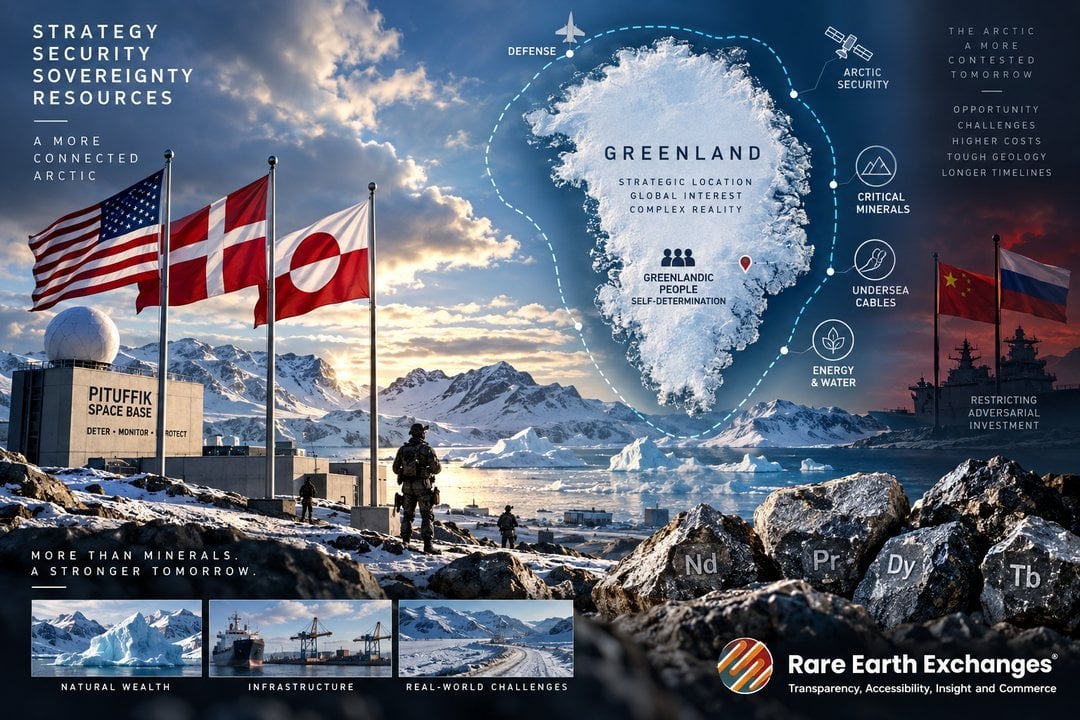
REEx Insight: Security Perimeter Before Supply Chain
For rare earths, the immediate significance is easily overstated. This agreement does not suddenly turn Greenland's deposits into mines.
Instead, it potentially establishes a geopolitical perimeter around future development. The supplied reporting says adversarial sensitive investments—including critical minerals—would be restricted. That matters for projects such as Tanbreez and Sarfartoq, but geology remains the easy part in some ways. Greenland's constraints include Arctic construction, limited infrastructure, permitting, skilled labor, ports, reliable energy and water, processing economics, and ultimately access to non-Chinese separation, metallization, and magnet manufacturing. In REEx's Great Powers Era 2.0™, Greenland increasingly resembles a strategic platform where defense, minerals, infrastructure, and sovereignty converge.
Washington Sees Defense; Copenhagen Sees Sovereignty
American coverage emphasizes strategic geography: Greenland sits astride Arctic approaches and already hosts the U.S. Pituffik Space Base, important to missile warning and space surveillance. AP reports the arrangement could expand America's military footprint while excluding non-NATO adversaries.
The Danish-European framing is noticeably different. Prime Minister Mette Frederiksen stresses that the arrangement recognizes the Kingdom's sovereignty and Greenlandic self-determination; French President Emmanuel Macron similarly welcomed preservation of Danish sovereignty and international law.
Some Danish analysts go further, arguing that Washington already possessed extensive basing rights under the 1951 defense agreement, making portions of the new arrangement closer to formalization than revolution.
The Bigger Strategic Bet
The mineral consequence may therefore come indirectly. Greater security certainty plus screening of Chinese or Russian strategic investment could make Western capital more comfortable financing Greenland's mines, power systems, ports, water infrastructure, and processing.
But military access cannot manufacture dysprosium, terbium, or NdFeB magnets.
Greenland could become an important Western mineral source. Turning Arctic geology into a secure mine-to-magnet supply chain remains the much harder assignment.
Why Greenland's Rare Earths May Remain in the Ground for Good
Frankly, the harder question is whether Greenland's rare-earth geology can ever overcome its economics. Thomas Kruemmer's Rare Earth Observer (REO) has repeatedly argued that enthusiasm outruns metallurgy. In his detailed examination of Kvanefjeld, Kruemmer describes a difficult lujavrite/steenstrupine orebody carrying uranium and thorium (opens in a new tab); he also points to earlier project work identifying deeper eudialyte-hosted material as technically and economically problematic and to substantial power requirements. In separate analysis of Tanbreez/Kringlerne, REO’s concern centers on eudialyte: a chemically complex silicate mineral for which economical, high-recovery processing has not been demonstrated at the industrial scale envisioned. REEx has highlighted the same warning in its coverage of both Tanbreez and Greenland more broadly.
The geology is only the first hurdle. Greenland has virtually no rare-earth mining history, limited roads, ports, power, and skilled labor, while Arctic construction and operating costs are high. Kvanefjeld additionally collides with Greenland's uranium restrictions and the politically difficult problem of radioactive residues. The critical industry blog has estimated that Kvanefjeld's proposed flowsheet could generate on the order of 90,000 tonnes of thorium-bearing radioactive waste over the mine life and has questioned previously reported recovery performance.
Tanbreez avoids much of Kvanefjeld's uranium problem and has potentially valuable heavy rare earths, but still must prove eudialyte processing, recovery, financing, and commercial-scale economics. The contrarian case is therefore not that Greenland lacks rare earths—it is that impressive resources are not the same thing as economically recoverable, financeable rare-earth products. AP's independent examination reaches a similar broader conclusion, citing difficult geology, infrastructure deficits, and Arctic operating conditions as persistent barriers.
Sources / Citations
- Reuters — “US and Denmark reach deal on Greenland, Trump says,” Sept. 18, 2026. Reporting on the emerging U.S.-Denmark-Greenland agreement, expanded U.S. military access, restrictions on adversarial bases and sensitive investments, and preservation of Danish/Greenlandic sovereignty. Reuters — U.S.-Denmark-Greenland deal (opens in a new tab)
- Associated Press — “Trump has a deal to build US military presence in Greenland while leaving island in Denmark’s hands,” Sept. 18, 2026. Covers the proposed permanent U.S. security role, China/Russia restrictions, Pituffik, and required Danish and Greenlandic parliamentary approval. Associated Press — Greenland security deal (opens in a new tab)
- The Telegraph — “Danes mock Trump for ‘status quo’ Greenland deal,” Sept. 19, 2026. Useful for the Danish/European perspective: Frederiksen's emphasis on sovereignty and self-determination, Macron's response, sensitive-investment restrictions covering critical minerals and undersea cables, and Danish arguments that existing U.S. defense rights were already extensive.
- U.S. Department of State — Agreement Amending and Supplementing the 1951 Defense of Greenland Agreement, 2004. Primary-source background for existing U.S. defense rights and U.S.-Danish-Greenlandic security cooperation. U.S. State Department — Greenland Defense Agreement (opens in a new tab)
- Associated Press — “Greenland's harsh environment and lack of infrastructure have prevented rare earth mining.” Examines why Greenland's mineral potential has repeatedly failed to become commercial production, including complex geology, eudialyte processing, scarce roads and power, skilled-labor constraints, Arctic costs, and environmental challenges. Associated Press — Greenland rare-earth development barriers (opens in a new tab)
- Thomas Kruemmer, The Rare Earth Observer — “Greenland's Kvanefjeld: ~90,000 t of Radioactive Waste?” Critical technical examination of Kvanefjeld's lujavrite/steenstrupine mineralogy, uranium/thorium burden, processing and recovery assumptions, power requirements, and projected radioactive residues. Rare Earth Observer — Kvanefjeld analysis (opens in a new tab)
- Rare Earth Exchanges — “A Singapore Photo-Op Meets Greenland Geology.” REEx analysis examining the disconnect between Greenland's large geological resources and the metallurgy, infrastructure, processing, and economics required to turn those resources into commercial rare-earth products. REEx — A Singapore Photo-Op Meets Greenland Geology
- Rare Earth Exchanges — “Tanbreez Signs Landmark Offtake Deal—But Greenland's Rare Earth Reality Remains Far More Complicated,” May 22, 2026. Examines Tanbreez/Kringlerne's potentially attractive heavy-REE basket against the unresolved challenge of industrial-scale eudialyte processing, Arctic infrastructure, financing, and project economics.


0 Comments
No replies yet
Loading new replies...
Moderator
Join the full discussion at the Rare Earth Exchanges Forum →