
Highlights
- Malaysia and Australia are discussing deeper cooperation in rare earth processing and domestic neodymium magnet manufacturing.
- Lynas and South Korea's JS Link are advancing a 3,000-tonne-per-year sintered NdFeB magnet plant in Kuantan, Malaysia.
- Malaysia is leveraging geopolitical competition between major powers to climb from raw resources toward higher-value manufacturing.
- The announcement remains preliminary with no investment figures, capacity details, technology partners, or construction timelines disclosed.
- Resource-rich nations globally are increasingly demanding downstream processing to capture separation, metals, alloy, and manufacturing margins.
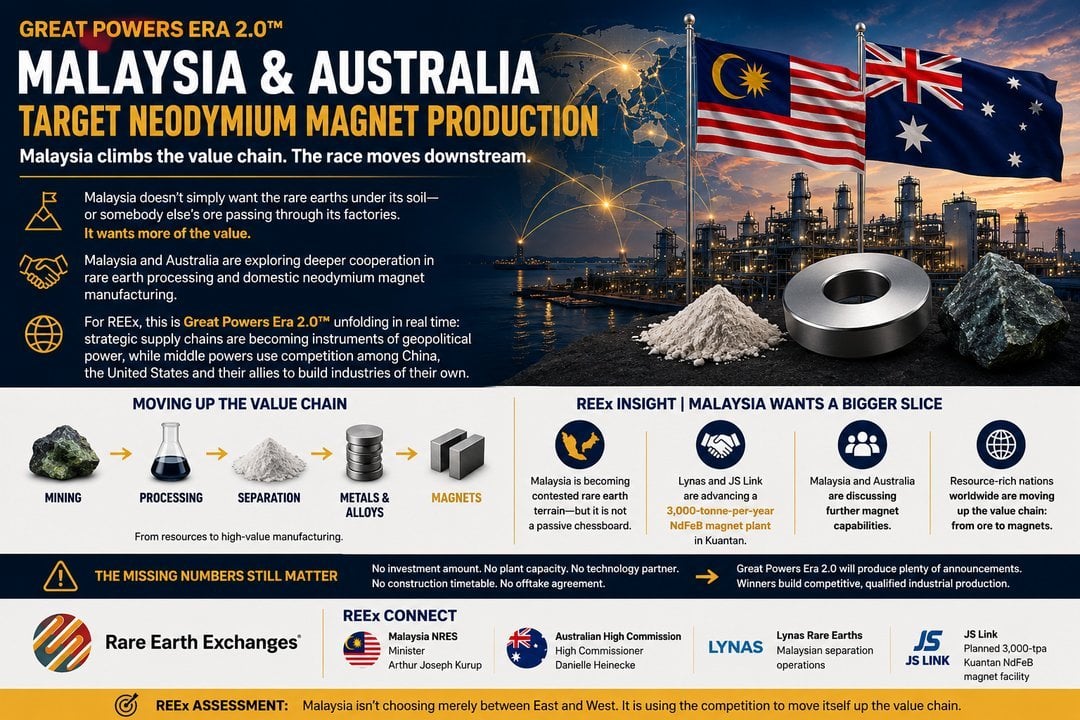
Malaysia doesn't simply want the rare earths under its soil—or somebody else's ore passing through its factories. It wants more of the value. Malaysia and Australia are exploring deeper cooperation in rare earth processing and domestic neodymium magnet manufacturing, another sign that Kuala Lumpur intends to climb from resources toward higher-value manufacturing. For REEx, this is Great Powers Era 2.0™ unfolding in real time: strategic supply chains are becoming instruments of geopolitical power, while middle powers increasingly use competition among China, the United States and their allies to build industries of their own.
REEx Insight | Malaysia Wants a Bigger Slice
Malaysia is becoming contested rare earth terrain—but it is not a passive chessboard.
Australian-owned Lynas already operates major separation capacity there. Lynas and South Korea's JS Link are advancing a 3,000-tonne-per-year sintered NdFeB magnet plant in Kuantan. Now Australia and Malaysia are discussing further magnet capabilities.
REEx has tracked Malaysia's emergence as a “Heavy Rare Earth Battleground” and argued that Great Powers Era 2.0 has arrived in Malaysia.
The larger pattern extends well beyond Malaysia. Resource-rich nations increasingly ask: Why export ore or concentrate while somebody else captures the separation, metals, alloy, and manufacturing margins? Indonesia has pursued downstream nickel processing; African governments increasingly seek domestic beneficiation; Australia is building processing capacity; Saudi Arabia is targeting minerals and manufacturing.
The Missing Numbers Still Matter
Malaysia's direction is strategically important. This particular announcement, however, remains preliminary: no investment amount, plant capacity, technology partner, construction timetable, or offtake was announced. That distinction matters. Great Powers Era 2.0 will produce plenty of announcements. The winners will be countries that turn geology and geopolitical leverage into competitive, qualified industrial production. Malaysia increasingly intends to be one of them.
REEx Connect
- Malaysia NRES — Minister Arthur Joseph Kurup
- Australia — High Commissioner Danielle Heinecke
- Lynas Rare Earths — Malaysian separation operations
- JS Link — Planned 3,000-tpa Kuantan NdFeB magnet facility
REEx assessment: Malaysia isn't choosing merely between East and West. It is using the competition to move itself up the value chain.


0 Comments
No replies yet
Loading new replies...
Moderator
Join the full discussion at the Rare Earth Exchanges Forum →