
Highlights
- NIOB's strongest drill hole at Bardy intersected an 8-metre syenitic pegmatite with visually identified allanite, a rare-earth-bearing mineral.
- No laboratory assays have yet confirmed rare earth grades or economic concentrations, making this a geological win rather than a commercial discovery.
- Allanite can host neodymium and praseodymium but presents metallurgical challenges; grade, recovery, and continuity remain unproven.
- NIOB controls nearly 30,000 hectares in Québec's Grenville Province and carries a market cap of approximately C$11.3 million as of March 2026.
- Investors should distinguish between visual mineralization and economic mineralization before drawing conclusions about Bardy's commercial potential.
North American Niobium and Critical Minerals (opens in a new tab) (CSE: NIOB) has reported its strongest drill hole to date at the Bardy project in Québec (opens in a new tab), intersecting an 8-metre syenitic pegmatite containing visually identified allanite, a recognized rare-earth-bearing mineral. The results validate the company's exploration model, but not yet its economic thesis. REEx assessment: Investors should distinguish between a geological success, a mineralogical success, and a commercial discovery. Laboratory assays, mineralogy, metallurgy, continuity, and ultimately economics—not visible minerals—will determine whether Bardy evolves into a meaningful rare earth project.
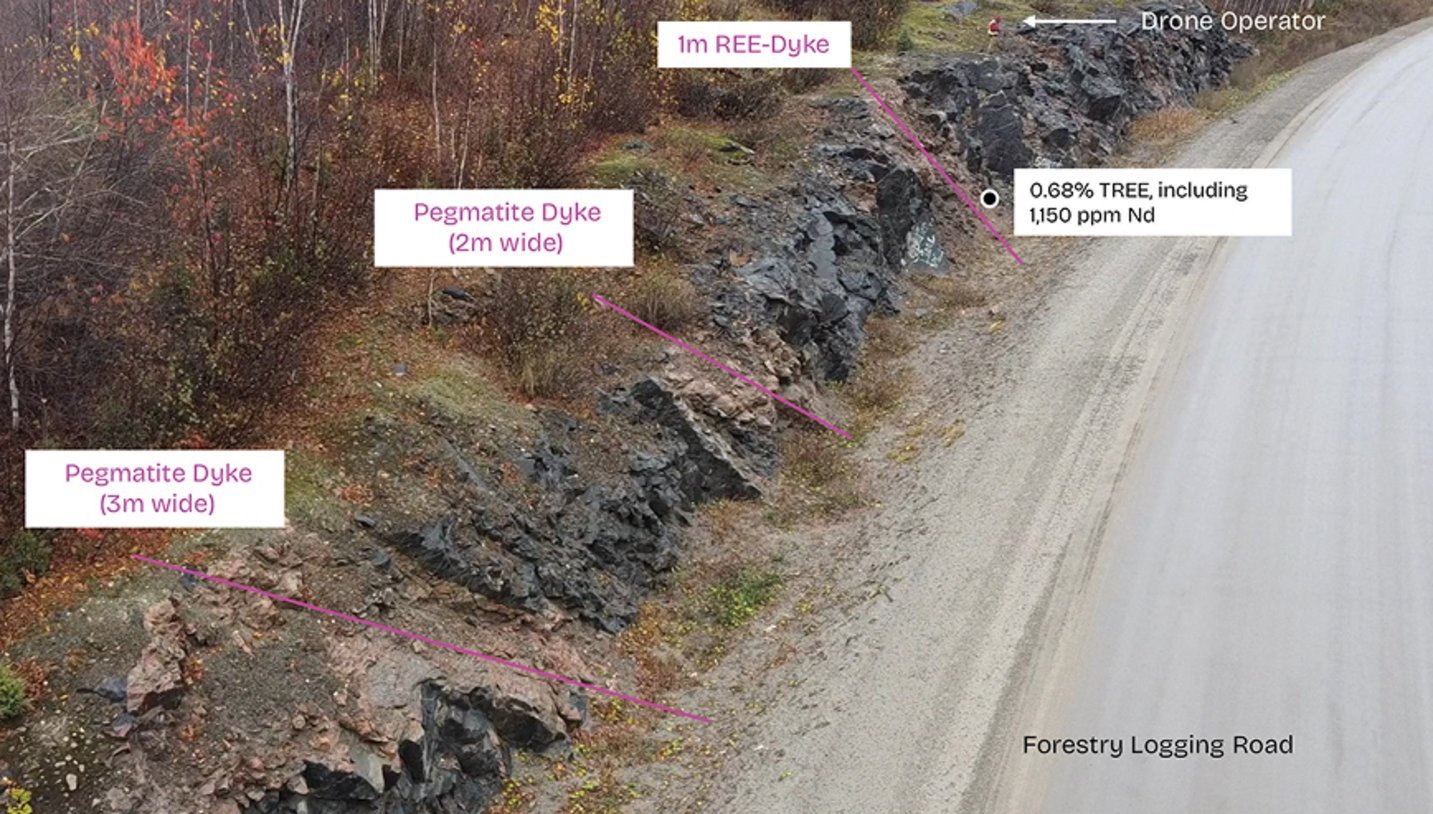
Every exploration program reaches a point when the rocks begin to answer back. NIOB's latest drill hole at Bardy may represent that moment—but only the first chapter.
The company intersected an 8-metre syenitic pegmatite containing visually identified allanite, including a 0.20-metre interval representing the strongest observed rare-earth-bearing mineralization of the current campaign. A second allanite-bearing interval higher in the hole reinforces the geological model, and the target itself was generated using radon anomalies and high-resolution magnetic surveys. Just as importantly, management repeatedly acknowledges that no laboratory assays have yet confirmed rare earth grades or economic concentrations. That disclosure deserves investor attention as much as the drill intercept itself.
Did you know? Allanite is a dark brown or black mineral belonging to the epidote group, famous for containing rare-earth elements.
A Geological Win—Not Yet an Economic One
The encouraging news is geological. Allanite is a legitimate rare-earth-bearing mineral capable of hosting neodymium, praseodymium, and other light rare earth elements. The drill results also suggest NIOB's exploration methodology is successfully locating mineralized pegmatites across its nearly 30,000-hectare land package in Québec's highly prospective Grenville Province. That is a meaningful exploration milestone. But geology alone does not build a mine.
The Questions That Still Matter
The headline does not establish a commercial rare earth discovery. Visible allanite does not reveal grade, recovery, mineral deportment, or economic value. In fact, allanite can present metallurgical challenges depending on its chemistry and liberation characteristics, making downstream processing every bit as important as the drill intercept itself. Investors still need laboratory assays, quantitative mineralogy, metallurgical testing, continuity between drill holes, resource estimation, and ultimately a viable development pathway.
For Rare Earth Exchanges®, the broader significance is strategic rather than immediate. North America urgently needs new rare earth discoveries outside China's supply chain, and Québec remains one of the continent's premier exploration jurisdictions. But investors should resist confusing visual mineralization with economic mineralization. Bardy has taken an encouraging step forward. Whether it becomes a mine remains an entirely different question.
Profile
North American Niobium and Critical Minerals Corp. (CSE: NIOB; OTCQB: NIOMF; FSE: KS82.F) is a Vancouver-based junior exploration company focused on discovering niobium, rare earth elements, and other critical minerals needed for North American technology, industrial, and defense supply chains.
Formerly First American Uranium, the company rebranded in late 2025 to reflect its strategic emphasis on critical minerals and now controls approximately 29,936 hectares across five wholly owned exploration properties in Québec's mineral-rich Grenville Province—Seigneurie, Seagull, Sabot, Blanchette, and Bardy—along with the Silver Lake property in British Columbia and an option on the Red Basin uranium-vanadium project in New Mexico. The company's investment thesis centers on advancing early-stage niobium and rare earth pegmatite targets in one of Canada's most prospective geological belts while benefiting from growing Western efforts to diversify critical mineral supply chains.
Investors should recognize, however, that NIOB remains an early-stage exploration company without defined mineral resources or economic studies on its flagship projects. Its value proposition therefore rests on successful exploration, resource delineation, metallurgy, financing, permitting, and ultimately demonstrating commercial viability rather than on existing production.
As of its March 2026 investor presentation, the company reported a market capitalization of approximately C$11.3 million, positioning it as a speculative but potentially high-upside participant in the North American critical minerals sector.
Register today: REEx Marketplace™ (opens in a new tab)


0 Comments
No replies yet
Loading new replies...
Moderator
Join the full discussion at the Rare Earth Exchanges Forum →