
Highlights
- New study maps how ASEAN countries could shift from fragmented raw material exporters to a coordinated, higher-value force in global critical minerals supply chains for nickel, tin, and rare earths.
- Indonesia, Myanmar, and Malaysia reveal the region's challenge: without alignment on ESG standards, midstream processing capacity, and policy coherence, ASEAN will continue shipping value and leverage overseas to Chinese processors.
- Investors should focus on midstream opportunities—separation, refining, and magnet capacity—especially projects with traceable feeds, low-carbon energy, and verifiable waste management as EU regulations tighten.
In Mineral Economics (Oct. 21, 2025), Vlado Vivoda (opens in a new tab) (University of Queensland), with Indra Overland and Roman Vakulchuk (NUPI), maps (opens in a new tab) how ASEAN could pivot from a fragmented exporter of nickel, tin, and rare earths to a coordinated, higher-value force in global supply chains. The study—“Navigating ASEAN’s critical materials future: Opportunities, risks and strategic imperatives”—argues that Indonesia’s upstream dominance (nickel), Myanmar’s REE mining, and Malaysia’s processing base reveal a hard truth: without regional alignment on ESG, midstream capacity, and policy coherence, the region will keep shipping value—and leverage—overseas.
Table of Contents
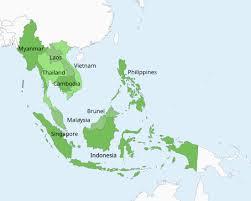
The 11 member countries of the Association of Southeast Asian Nations (ASEAN) are Brunei, Cambodia, Indonesia, Laos, Malaysia, Myanmar, the Philippines, Singapore, Thailand, Timor-Leste (East Timor), and Vietnam. These nations are focused on promoting economic growth, political stability, and cultural cooperation throughout the region.
ASEAN Nations
What rings true—and what it means
The paper’s diagnosis tracks with industry reality. Indonesia supplies the world with nickel but leans on Chinese-owned capital, technology, and coal-fired power for refining; value capture is real, autonomy less so. Myanmar’s heavy REE flows feed Chinese processors almost exclusively, a textbook case of upstream risk without downstream agency. Malaysia, by contrast, shows what’s possible: stable rules and social license can host separation plants and pull the region a notch down the value chain. The authors’ triad—environmental sustainability, supply-chain autonomy, and regional coordination—isn’t a slogan; it’s the only route to durable pricing power and market access as the EU’s CBAM and battery passport bite.
Investor translation: where the puck is going
For capital, the signal is clear. Midstream is the battleground: separation, refining, magnet, and alloy capacity inside ASEAN (Malaysia today; Vietnam and Thailand next) rewrites who earns the margin. Singapore’s role as a trade, finance, and stockpile hub is not window dressing; it’s the plumbing that makes diversification real. Expect premium multiples for projects that can prove traceable feeds, low-carbon process energy, and verifiable waste management. Also, watch the chemistry drift: as LFP grabs share, nickel-dependent theses must evolve toward stainless, aerospace, and specialty alloys—or risk obsolescence.
Limitations: where the study can’t carry you
This is a policy synthesis, not plant-by-plant due diligence. Country data are uneven; Myanmar’s opacity is a known blind spot. The framework assumes political will for regional alignment (AMCAP-III with teeth), yet ASEAN’s history has been bilateralism rather than bloc action. Finally, technology and trade rules are moving targets; timelines and cost curves for clean refining may shift faster than ministries can legislate.
Bottom line
ASEAN’s choice is stark: compete as scattered pits at the mercy of foreign processors—or act as a regional system that sets standards, finances midstream, and sells certified molecules the world must buy. The authors hand policymakers and investors a workable compass. The work now is to fund pipes, permits, and people so the map becomes territory.
Citation: Vivoda V., Overland I., Vakulchuk R. Navigating ASEAN’s critical materials future: Opportunities, risks and strategic imperatives. Mineral Economics, Open Access, Oct. 21, 2025.
©!-- /wp:paragraph -->


0 Comments
Discuss this article