
Highlights
- The Strait of Hormuz crisis acts as a cost multiplier for rare earth production, impacting mining fuel, separation processes, and logistics while the U.S. builds domestic capacity that won’t reach commercial scale until 2028–2030.
- China maintains a system-wide integration advantage across mining, separation, and magnet manufacturing, threatening U.S. industry with dual pressure from price shocks and forced DFARS compliance allocation.
- The Trump administration has a strategic window to convert the Middle East crisis into an industrial advantage by fast-tracking permitting, securing allied partnerships, and implementing transparent industrial policy while de-escalating energy disruption.
The Strait of Hormuz is not just an energy chokepoint—it is a cost transmission mechanism. Roughly 20% of global oil flows through it. As conflict escalates, oil volatility feeds directly into:
- Mining fuel costs
- Chemical-intensive separation processes
- Equipment logistics and freight
- Insurance and financing for long-duration projects
This is best understood not as a shock, but as a persistent industrial cost multiplier.
REEx ex-China Supply Chain: Where the U.S. Stands: Real Progress, Real Constraints
There is meaningful progress:
- MP Materials is anchoring domestic production, with DoD backing and downstream magnet investment
- USA Rare Earth advancing Round Top and Stillwater
- Ucore Rare Metals, Energy Fuels, and Aclara Resources are targeting midstream separation
- ReElement Technologies and Vulcan Elements are pursuing magnet scale—feedstock Pensana, others, and recycling
- Lynas inks deal with U.S. Pentagon for access
But constraints are structural:
- Heavy rare earth supply (Dy, Tb) remains notably limited
- Separation capacity remains nascent
- Magnet manufacturing at scale remains unproven domestically
The reality: 2028 is a milestone—not a finish line. A 12–24-month slippage remains highly plausible per REEx Insights modeling. This could take us into 2030 before achieving commercial-scale palpability. This means the second half of 2026 through 2028, and even into 2030, can be quite painful for U.S. industry.
The China Variable: System Advantage Still Intact
China’s advantage is not just volume—it is system integration:
- Mining
- Separation
- Metal/alloy production
- Magnet manufacturing
Follow Rare Earth Exchanges™ and note the Chinese government’s multiple moves to reinforce control over the refining and magnet position. They continue to announce decisions bolstering this momentum on nearly a daily basis.
If China further tightens exports—or prioritizes domestic consumption—the U.S. faces dual pressure:
- Immediate price and availability shock
- Forced allocation under DFARS compliance
In that scenario, defense and select OEMs get the supply first.
The rest of the U.S. industry—automation, HVAC, medical, electronics—absorbs the disruption.
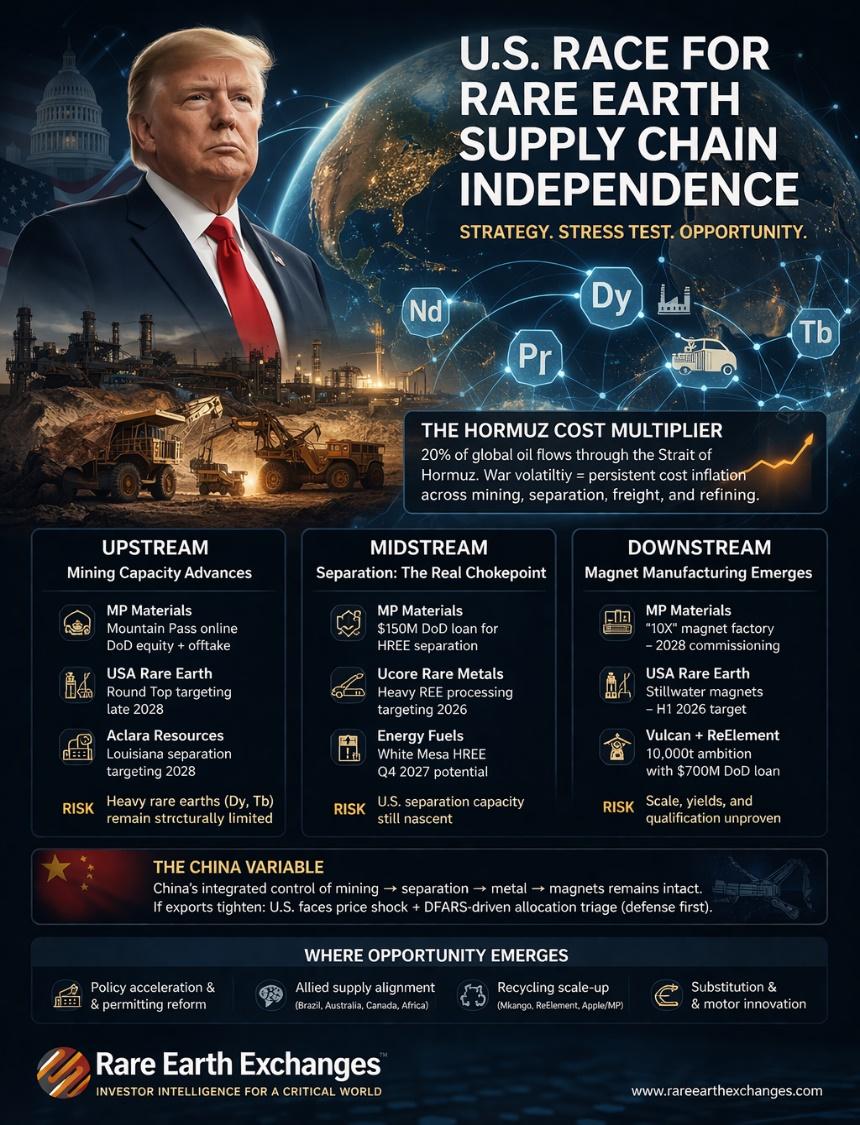
Where Opportunity Emerges in Crisis
Paradoxically, the current shock creates openings for President Trump’s administration:
- Policy acceleration: Crisis conditions can justify faster permitting and capital deployment—now is an emergency. Is Washington paying attention?
- Price signals: Higher magnet prices improve project economics for U.S. producers
- Allied alignment: Brazil, Australia, Canada, and Africa become more strategic partners—this needs to be tightened up, systematized even further.
- Recycling economics: Projects like Mkango/HyProMag and ReElement gain relevance faster
- Substitution innovation: Motor design and magnet alternatives may finally receive serious investment.
In short: crisis compresses decision-making—even if it does not compress physics. But President Trump must now find a credible off-ramp from escalating energy disruption—because prolonged instability in the Strait of Hormuz, which carries roughly 20% of global oil flows, is already transmitting cost shocks across industrial supply chains, from metals to defense inputs. The opportunity is not in escalation—it is in conversion: turning a Middle East crisis into a framework formutual economic stabilization and long-term industrial rebuilding,potentially including pragmatic pathways for regional reintegration of Iran where feasible. At the same time, the administration should leverage the urgency to accelerate rare earth and critical mineral resilience—fast-tracking permitting, aligning allied supply chains, and deploying capital with precision. The strategic objective is clear: de-escalate energy destruction while accelerating supply chain construction—because in this environment, stability is not separate from industrial policy; it is a prerequisite for it.
Bottom Line: Strategy Meets Stress Test
The United States is attempting to rebuild a complex supply chain under simultaneous geopolitical and cost pressure. Directionally, the strategy is sound. Operationally, it remains incomplete.
Rare earth supply chains reward sequencing, integration, and execution—not urgency alone. The Hormuz shock doesn’t stop the buildout—but it raises the stakes, the costs, and the consequences of delay.
Trump faces a narrow window to turn a geopolitical crisis into a strategic advantage: find a credible off-ramp in the Iran conflict while leveraging the urgency to accelerate the U.S. buildout of the rare earth and critical mineral supply chain. That means moving beyond rhetoric to execution—fast-tracking permitting, expanding Defense Production Act authorities, securing long-term offtake agreements, and coordinating capital across DoD, DOE, and private markets. Not to mention a suite of other tools, including talent development and a public works program focused on critical minerals infrastructure.
Industrial policy must become predictable, disciplined, and transparent, not reactive or led by financial intermediaries. The objective is clear: de-risk upstream mining, unlock midstream separation at scale, ensure downstream magnet manufacturing is bankable and competitive, and, in parallel, support further innovation downstream.
At the same time, dialing down political noise and maintaining cross-party continuity will be essential to avoid post–midterm volatility that could stall investment cycles. In rare earths, capital follows clarity—and right now, clarity is as strategic as the minerals themselves.


0 Comments
No replies yet
Loading new replies...
Moderator
Join the full discussion at the Rare Earth Exchanges Forum →