
Highlights
- President Tokayev declared the current moment 'unique' for mineral-rich nations and ordered a strategy covering exploration, processing, mine-waste recovery, and workforce development.
- Kazakhstan holds 15 known rare-earth deposits but lacks commercial-scale separation and magnet production, making processing the critical missing link.
- Lindian Resources acquired control of Kazakhstan's SARECO rare-earth-carbonate processing facility, signaling growing foreign capital interest in downstream capacity.
- Kazgeology JSC, the state geological exploration company, is central to converting Kazakhstan's geological promise into investable, drill-defined mineral projects.
- Kazakhstan's strategic position between China and Russia while courting Western partners makes it a natural arena for Great Powers Era competition over critical minerals.
Kazakhstan understands that the rocks beneath Central Asia have become geopolitical bargaining chips. President Kassym-Jomart Tokayev has ordered a broader critical-minerals strategy spanning exploration, processing, mine-waste recovery, laboratories, and workforce development. No new mine was announced. The real development is strategic: Kazakhstan wants to convert geology into industrial power.
Kassym-Jomart Tokayev
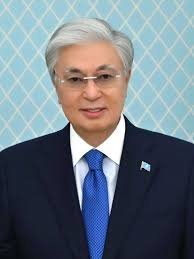
Source: Wikipedia
REEx Insight: Great Powers Era 2.0 Arrives on the Steppe
Tokayev called today's environment “unique” for countries holding critical minerals as reinforced (opens in a new tab) in Kazinform. He is right. Kazakhstan sits between China and Russia, while courting Washington, Brussels, and other partners. REEx previously identified the country as potentially one of the most important non-Chinese mineral jurisdictions—but emphasized that 15 known rare-earth deposits do not yet equal commercial-scale separation or magnet production. That geography makes Kazakhstan a natural battlefield in Great Powers Era 2.0™.
From Soviet Metallurgy to a New Supply Chain
Unlike many emerging mineral jurisdictions, Kazakhstan is not starting from zero. Existing uranium, beryllium, and metallurgical capabilities provide industrial foundations. Akbulak is also undergoing modern drilling, although its Soviet-era estimate of roughly 380,000 tonnes of rare-earth oxides remains unverified under JORC or NI 43-101 standards.
REEx has also tracked the more important downstream movement: Lindian Resources acquired control of Kazakhstan's SARECO mixed rare-earth-carbonate processing facility, while ANSTO subsequently validated strong recoveries for its intended Kangankunde feedstock. This fits the broader Central Asian pattern REEx identified in July: the rocks are there; capital is arriving; processing remains the missing link.
Tokayev now appears to recognize precisely that. China is next door. Russia is embedded. Europe needs supply. America wants diversification. Kazakhstan's greatest asset may ultimately be neither ore nor geography—but its ability to make all four powers compete for access to both.
Kazgeology JSC Profile
Kazgeology JSC (opens in a new tab) is Kazakhstan’s national geological exploration company, established in 2011 and brought under state mining holding Tau-Ken Samruk in 2021; it received national geological exploration company status in 2023. Kazgeology operates across Kazakhstan conducting exploration and solving technical geological problems for mining companies and investors. The company reports more than 200 specialists, over 44 projects completed since inception, and more than KZT50 billion in attracted investment. Its recent work includes gold, copper, polymetallic, and copper-porphyry exploration for companies including Kazakhmys and Kazzinc.
For Rare Earth Exchanges® readers, Kazgeology matters because it represents part of the state-backed technical infrastructure needed to convert Kazakhstan’s enormous geological promise into drill-defined, investable mineral projects. In Great Powers Era 2.0™, that capability becomes increasingly strategic: Kazakhstan may possess the rocks, but organizations such as Kazgeology are responsible for generating the geological evidence required before those rocks can credibly enter Western or Chinese critical-mineral supply chains.


0 Comments
No replies yet
Loading new replies...
Moderator
Join the full discussion at the Rare Earth Exchanges Forum →