
Highlights
- A rare earth oxide can meet every purity specification and still fail as feedstock for magnets, lasers, catalysts, or semiconductors due to structural factors.
- Crystal alignment, grain boundaries, oxidation state, and surface chemistry often matter more than elemental composition in high-performance applications.
- World-class characterization labs, pilot plants, and qualification programs are becoming strategic assets—not just support functions—in the ex-China supply chain.
- Sophisticated buyers are shifting from asking 'Is this 99.99% pure?' to demanding reproducibility, phase composition data, and application-specific qualification.
- The next competitive advantage in rare earths will belong to companies that engineer predictable performance, not those chasing another decimal place of purity.
Everyone in the rare earth industry talks about purity. Buyers routinely specify 99.5%, 99.99%, or even 99.999% ("five nines") rare earth oxides, assuming that each additional decimal place translates into a superior product. Chemical purity is certainly essential—but it is only one dimension of quality. In reality, a rare earth material's commercial value depends just as much on its crystal structure, grain morphology, phase composition, surface chemistry, and processing history as it does on the number printed on its certificate of analysis.
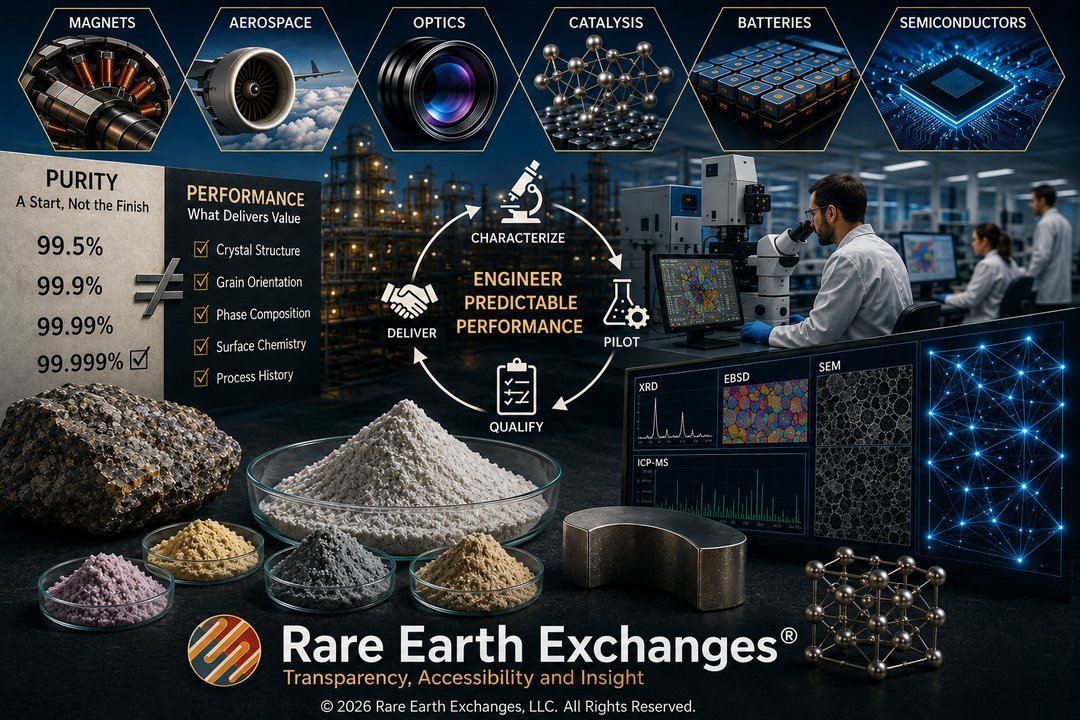
A rare earth oxide can satisfy every chemical specification on its certificate of analysis and still fail as feedstock for a permanent magnet, laser crystal, catalyst, semiconductor, or advanced ceramic. Why? Because functional performance depends on far more than elemental chemistry. Crystal orientation, grain structure, particle morphology, oxidation state, surface chemistry, and processing history frequently determine whether a material succeeds—or fails—in its intended application. In advanced materials, purity is merely the admission ticket. Performance is what earns commercial value.
REEx Insight
The rare earth market ex-China is actually not so much trading commodities as it is qualifying engineered materials. Tomorrow's customer may no longer purchase "99.99% neodymium oxide." Rather, they’ll seek material certified for a specific NdFeB magnet, aerospace alloy, optical crystal, battery chemistry, catalyst, or defense application. That changes the competitive landscape.
The companies creating the greatest value will not necessarily be those producing the highest-purity oxides. They will be those capable of consistently delivering materials whose chemistry, crystal structure, microstructure, surface condition, and manufacturing history are fully understood, reproducible, and validated for a customer's exact application. A more precise, adept specialty commerce.
This evolution elevates an entirely different set of capabilities. Flexible mineral characterization. Advanced analytical laboratories. Metallurgical piloting. Process optimization. Product qualification. Failure analysis. Rapid iteration between producer and customer seems to be an important area for American industrial policy, for example.
No longer support functions, these become strategic assets, critical underlying shared services. All this means we suspect the next competitive advantage is unlikely to come from another decimal place of purity. It will come from the ability to engineer predictable performance.
Purity Isn't the Whole Story
The familiar progression from 99.5% to 99.9%, 99.99%, and ultimately 99.999% purity simply describes how much of the desired element is present. It says remarkably little about how that material will actually behave.
A "five nines" material can still underperform because of grain orientation, crystal defects, phase composition, oxidation state, particle-size distribution, contamination introduced during downstream processing, or inadequate thermal treatment. In other words, purity describes chemistry. It does not describe engineering.
Increasingly, directed, precision engineering is where the value resides.
Why Crystal Structure Matters
Once chemistry is no longer the sole determinant of quality, attention shifts to the material itself—how atoms are arranged, how grains interact, and ultimately how the material performs. This is particularly evident in NdFeB permanent magnets. Crystal alignment largely determines remanence, while grain boundaries strongly influence coercivity. Heavy rare earth diffusion, grain refinement, and heat treatment can dramatically improve magnetic performance without materially changing the overall chemical assay.
The same principle extends well beyond magnets. In laser ceramics, randomly oriented grains scatter light and reduce optical efficiency. In catalysts, different crystal facets expose different atomic surfaces, producing dramatically different catalytic activity despite identical chemistry. Semiconductor materials likewise depend on defect density, crystallographic orientation, and microstructure to achieve desired electrical performance.
The fascinating lesson is straightforward.
Two materials can share identical chemical analyses yet perform dramatically differently because their internal structures evolved differently during processing. In advanced manufacturing, structure frequently outweighs composition.
Characterization Creates Value
Understanding those structural differences requires something many Western supply chains still lack: world-class characterization capability. Mining discovers ore. Characterization determines whether that ore can become a commercially valuable product.
Tomorrow’s competitive advantage may increasingly belong to organizations capable of rapidly characterizing, piloting, refining, and qualifying new materials. That requires integrating analytical techniques such as ICP-MS, X-ray diffraction (XRD), scanning electron microscopy (SEM), electron backscatter diffraction (EBSD), secondary ion mass spectrometry (SIMS), glow discharge mass spectrometry (GD-MS), automated mineralogy, and metallurgical testing—not simply to generate laboratory reports, but to understand why one material consistently outperforms another.
Just as important is piloting capability. Bench-scale and pilot-scale processing enable companies to optimize cracking, leaching, solvent extraction, precipitation, calcination, reduction, alloying, and magnet production long before committing hundreds of millions of dollars to commercial facilities. Pilot plants provide the bridge between laboratory science and industrial reality, allowing producers to qualify products with customers, refine process flows, reduce technical uncertainty, and accelerate commercialization.
Sophisticated instrumentation alone, however, is insufficient. A laboratory can produce an exceptionally precise answer that is still wrong if the sample itself is not representative. Poor sampling, contamination, incomplete digestion, matrix effects, calibration errors, or phase misidentification can all produce technically precise—but commercially misleading—results. Ultimately, characterization is not about generating numbers. It is about generating confidence.
What Buyers Should Really Ask
The most sophisticated buyers are beginning to ask different questions.
Instead of asking: "Is this material 99.99% pure?"
They may
increasingly ask:
- What impurities are present—and where are they located?
- Which crystalline phases are present?
- What is the grain structure and particle morphology?
- How reproducible is the manufacturing process?
- Has this material been successfully qualified in my application?
- Has it been consistently produced at pilot scale?
- Can the supplier reproduce the same specification at commercial volumes?
These questions move procurement beyond commodity purchasing toward technical qualification.
They also determine which suppliers become long-term strategic partners.
Conclusion
Rare earths are often described as strategic commodities, but that characterization increasingly misses the point.
They are precision-engineered materials whose value lies not simply in elemental composition, but in how atoms are arranged, processed, characterized, and ultimately qualified for demanding industrial applications.
As defense, aerospace, semiconductor, energy, robotics, and advanced manufacturing supply chains tighten specifications, the highest-value companies may not be those with the largest deposits—or even the purest products.
Rather, they will be those capable of rapidly characterizing new materials, piloting innovative process flows, solving complex metallurgical challenges, and consistently delivering application-specific performance. For the emerging Western or “ex-China” rare earth supply chain, this represents an important strategic imperative based on our unfolding understanding.
Mines create opportunity. Refineries create products. But characterization laboratories, pilot plants, qualification programs, and advanced process engineering create enduring competitive advantage. The future of rare earths will likely not be defined by who produces the most material. It will be defined by who understands it best.
REEx Connect North America
| Organization | Type | Core Strengths |
|---|---|---|
| Ames National Laboratory – Critical Materials Innovation Hub | U.S. National Laboratory | Rare earth metallurgy, metals and alloys, permanent magnets, recycling, pilot-scale processing, technology commercialization |
| National Energy Technology Laboratory (NETL) | U.S. National Laboratory | Coal ash and mine waste recovery, unconventional rare earth feedstocks, hydrometallurgy, process scale-up |
| Oak Ridge National Laboratory | U.S. National Laboratory | Advanced materials characterization, electron microscopy, crystallography, advanced manufacturing |
| Idaho National Laboratory | U.S. National Laboratory | Critical minerals processing, process engineering, pilot demonstrations, techno-economic analysis. Just announced launched Department of War antimony pilot facility and ramping up rare earth separation expertise |
| Lawrence Livermore National Laboratory | U.S. National Laboratory | Surface science, spectroscopy, computational materials science, advanced characterization |
| U.S. Geological Survey Denver Microbeam Laboratory | Federal Laboratory | Mineral characterization, electron microprobe analysis, SEM, automated mineralogy, rare earth mineral identification |
| National Institute of Standards and Technology (NIST) | Federal Laboratory | Measurement science, certified reference materials, analytical validation, metrology and standards |
| Colorado School of Mines | University | Mineral processing, extractive metallurgy, beneficiation, pilot testing, critical minerals research |
| Virginia Tech | University | Mineral processing, flotation, rare earth beneficiation, critical minerals characterization, process development (Dr. Aaron Noble research group) |
| South Dakota Mines | University | Critical minerals research, AI-assisted mineral characterization, beneficiation, rare earth exploration technologies |
| Missouri University of Science and Technology | University | Hydrometallurgy, extractive metallurgy, critical minerals processing, process development |
| SGS | Commercial Laboratory | Global mineral characterization, metallurgical testing, pilot plants, feasibility studies, process optimization. HQ in Switzerland |
| ALS | Commercial Laboratory | Mineral characterization, metallurgical pilot plants, analytical chemistry, process optimization, product qualification. HQ Australia |
| Bureau Veritas | Commercial Laboratory | Metallurgical testing, flotation, hydrometallurgy, mineral processing, process development. HQ France |
| Saskatchewan Research Council | Applied Research Organization | Commercial rare earth separation, solvent extraction, oxide production, pilot processing, customer qualification |
| ReElement Technologies | Commercial Company | Chromatographic rare earth separation, purification, pilot-scale production, customer qualification |
| University of Kentucky Center for Applied Energy Research | University Research Center | Rare earth recovery from coal ash and acid mine drainage, hydrometallurgy, pilot-scale critical minerals processing |
| Energy Fuels | Industrial Operator | Monazite cracking, rare earth carbonate production, solvent extraction development, commercial process optimization, integrated uranium–rare earth processing |
| MP Materials | Industrial Operator | Rare earth beneficiation, separation, NdPr oxide production, metal and magnet manufacturing, pilot-to-commercial qualification and integrated supply chain |
| Phoenix Tailings | Industrial Operator | Phoenix Tailings focuses on both rare earth separation and metallization, operating an integrated platform that handles both critical midstream stages |
Europe, Australia, Asia and Middle East
Note groups in Europe include Carester, Solvay, Neo Performance Materials, REEtec. MP Materials, the U.S. Department of Defense, and Saudi Arabian Mining Company (Maaden) formed a joint venture to build a rare earth refinery in Saudi Arabia. Lynas Rare Earths continues to expand its separation facility in Malaysia while Iluka Resources is building its rare earth refinery in Eneabba, Western Australia. Australian Nuclear Science and Technology Organisation (ANSTO) is a national research organization focusing on rare earth chemistry, solvent extraction, pilot plants, commercial process optimization, and critical minerals R&D. Also, CSIRO is another Australian national research organization focusing on critical minerals research, mineral processing, AI-enabled characterization, pilot testing, and process development. Mkango Resources is focused on separation with an emphasis on recycling starting in UK and Germany. Note several Japanese companies are involved in processing, refining, or establishing domestic smelting and separation capabilities for rare earth elements, for example Shin-Etsu Chemical (opens in a new tab), Mitsubishi Materials (opens in a new tab), and Mitsui Kinzoku (opens in a new tab). Japan relies heavily on external partnerships (such as via Sojitz Corporation (opens in a new tab) and Iwatani Corporation (opens in a new tab) with international separators like Lynas) but is expanding domestic refining infrastructure.
Sources: ISO Technical Committee 298 (Rare Earth); U.S. Geological Survey; National Institute of Standards and Technology (NIST); Ames National Laboratory Critical Materials Innovation Hub; peer-reviewed literature on NdFeB magnet microstructure, transparent rare earth ceramics, ceria catalysis, crystallography, and materials characterization.


0 Comments
No replies yet
Loading new replies...
Moderator
Join the full discussion at the Rare Earth Exchanges Forum →