
Highlights
- China controls roughly 98% of heavy rare earth processing, with China Rare Earth Group holding all ion-adsorption extraction quotas for medium-heavy REEs.
- Brazil's ionic clay deposits, including USA Rare Earth's Serra Verde and Meteoric Resources' Caldeira, are emerging as the strongest geological challengers to Chinese dominance.
- Myanmar's 600-plus unregulated mining sites in conflict zones represent one of the world's most controversial critical-mineral supply chains feeding Chinese processors.
- Australia, Namibia, Sweden, Greenland, and North America are advancing diverse HREE geological systems, from xenotime to peralkaline intrusions and iron-oxide-apatite deposits.
- Finding rare earths is only the beginning—solvent extraction separation remains the true choke point, and no non-Chinese project has yet proven continuous commercial-scale output of separated Dy, Tb, and Y.
The world does not lack rare earths; it lacks easy-to-mine, economical sources of the heavy rare earth elements—and especially the ability to separate them outside China. Dysprosium (Dy), holmium (Ho), erbium (Er), thulium (Tm), ytterbium (Yb) and lutetium (Lu), together with closely associated yttrium (Y), occur in several geological settings, but the richest strategic supply chain has grown around weathered ionic-adsorption clays in southern China and Southeast Asia. China controls about 98% of heavy-rare-earth processing capacity by some recent estimates; the International Energy Agency puts China's broader share of magnet-rare-earth refining at 90% in 2025. Southern China remains the heart of the business, while Myanmar, Laos and Malaysia feed a wider regional system. Australia and Brazil are now the strongest geological challengers, with projects emerging in Africa, India, Europe, Greenland and North America.
REEx Insight: The Best Ore Is Not Always the Highest-Grade Ore
REEx sees a geological race between hard rock and soft clay—but the real contest is downstream. A spectacular hard-rock grade may be expensive to crush, roast and chemically crack. An ionic clay can carry only a few hundred or few thousand parts per million REE, yet weathering has already freed some rare-earth ions from their original minerals and parked them on clay surfaces. A salt solution can exchange places with those ions and wash them into solution. In effect, nature has already performed part of the processing. Research on southern Chinese deposits places typical ionic-clay grades around 0.05–0.2% TREO, sometimes higher, with REEs adsorbed largely on minerals such as kaolinite.
That is why southern China's clay belt matters so much—and why similar geology in Brazil has become one of the hottest exploration stories in rare earths.
Where the Heavy Rare Earths Hide
There is no single "rare-earth geology." Different rocks create very different baskets.
| Geological system | Where HREEs sit | HREE character | Mining/process challenge |
|---|---|---|---|
| Ion-adsorption clay / weathered regolith | REE ions attached to kaolinite, halloysite and other clays | Often Y, Dy, Tb, Er, Yb-rich | Low grade, but relatively gentle salt leaching |
| Xenotime systems | Xenotime, YPO₄ | Strong Y + HREE enrichment | Mineral concentration, then chemical cracking |
| Carbonatite / laterite | Carbonate, phosphate and weathering minerals | Usually LREE-rich; special systems can carry HREE | Generally harder chemical treatment |
| Heavy-mineral sands / placers | Monazite and xenotime grains concentrated by water/waves | Xenotime supplies Y/HREE; monazite usually LREE-rich | Physical separation helps; Th/U can complicate processing |
| Peralkaline granite/syenite, pegmatite, hydrothermal and IOA systems | Eudialyte, xenotime, monazite, apatite and complex silicates | Can be unusually Y/HREE-rich | Often complex mineralogy and difficult metallurgy |
Carbonatites are generally strongest in light REEs, while ion-adsorption clays and xenotime are the standout geological hosts for heavies.
Southeast Asia Forms the HREE Heartland
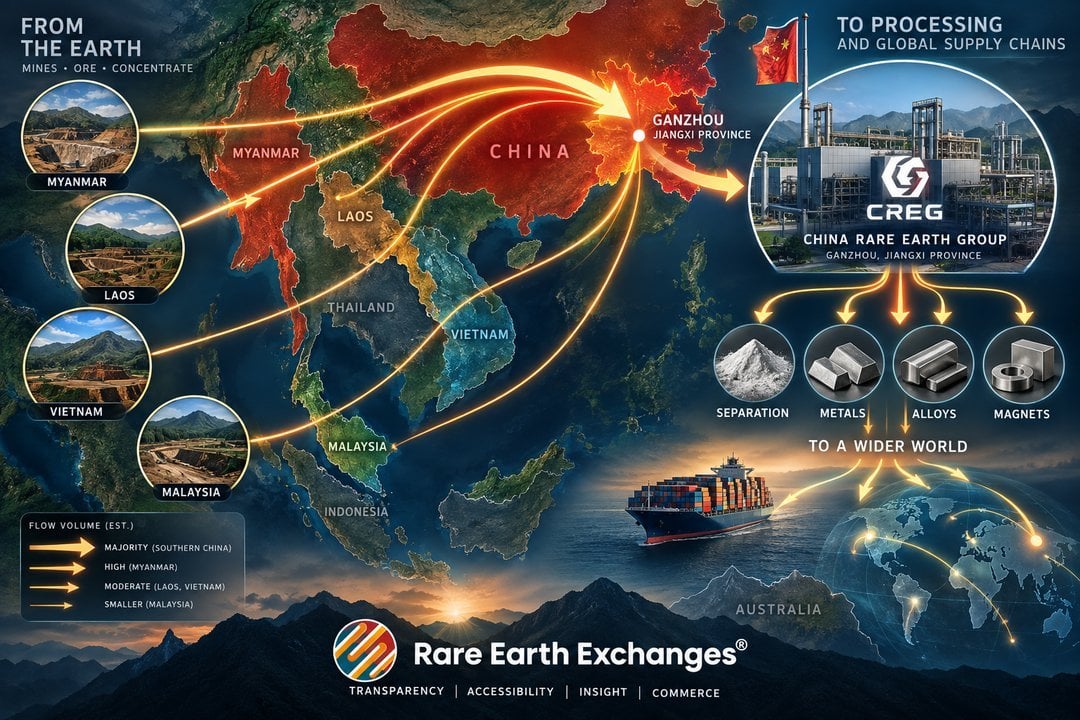
Southern China's belt across Jiangxi, Fujian, Guangdong, Guangxi and Yunnan is the classic ion-adsorption province. By 2024, the IEA reports that China Rare Earth Group had been allocated all of China's ion-adsorption, medium-heavy rare-earth extraction quotas, giving the state-owned group an extraordinary position in the upstream HREE chain. China Rare Earth Group, headquartered in Ganzhou, Jiangxi, was created through state-led consolidation and controls ionic and hard-rock assets across several southern provinces.
Myanmar has become equally important as an ore source. But the often-repeated claim of "500-plus open mines" needs care. Stimson Center satellite analysis counted at least 549 unregulated rare-earth mining sites by late 2025 and more than 600 by 2026—these are mapped mining/leaching sites, not 600 independently audited commercial mines. Much activity is concentrated in Kachin State, as well as Shan and Wa States, near China, and uses in-situ leaching. Conflict, armed-group control and water contamination make this one of the world's most controversial critical-mineral supply chains. Kachin and Wa States, referred to as Myanmar Rebels, are ranked number one of the REEx Insights™ Heavy Rare Earth Upstream Rankings. Much of the mining offtake from Myanmar is shipped across the border to Kunming and eventually to separation centers associated with, or owned by, China Rare Earth Group.
Laos is the next fast-moving frontier. Stimson identified at least 26 operating rare-earth sites, while recent geology at Meng Khun shows that tropical weathering can transform an initially LREE-rich granodiorite into an HREE-enriched ionic deposit. As REEx has reported, much of the activity to mine rare earth elements involves Chinese businesses. Vietnam has ionic-clay occurrences and experimental ammonium-sulfate leaching, although its better-known deposits include harder-rock systems. Malaysia hosts ionic-clay prospects associated with deeply weathered granites in its Western Belt, while Lynas' Malaysian plant separately processes Australian feed and has become an important non-Chinese HREE separation center.
An emerging ex-China HREE contender—though not yet independent of China's value chain—is Southern Alliance Mining (SGX: QNS) through its ownership of MCRE Resources, which is developing Malaysia's rare earth resources. The strategic wrinkle is important: while the resource sits outside China, MCRE has entered into offtake arrangements that send rare-earth material into China, underscoring the central challenge facing new HREE suppliers—developing not only non-Chinese resources, but also independent separation and refining capacity.
Indonesia offers another reminder that an REE occurrence is not automatically an orebody: the recent Lapindo mud review found Dy, Ho, Er, Tm, Yb and Lu, but the sediments remain LREE-dominated and have not been demonstrated to be economically recoverable.
Australia, Brazil and the Global Search Move Upfield
Australia: Northern Minerals' Browns Range in Western Australia is a rare hard-rock HREE story built around xenotime. Its Wolverine deposit is described by the company as Australia's highest-grade known Dy-Tb deposit. Mount Weld is different: a carbonatite-derived weathering system feeding Lynas' mine-to-Malaysia processing chain.
Brazil may be the biggest geological wildcard. Serra Verde's Pela Ema operation, now owned by USA Rare Earth (NASDAQ: USAR), became a commercial-scale ionic-clay producer in 2024 and produces a basket containing Nd, Pr, Dy and Tb. USA Rare Earth completed its roughly $2.8 billion combination with Serra Verde in September 2026. Meteoric Resources (ASX: MEI) and its huge Caldeira resource, Viridis Mining & Minerals (ASX: VMM) and its Colossus project, and Brazilian Critical Minerals (ASX: BCM) and its Ema project are all weathered ionic-clay systems. Brazilian Rare Earths (ASX: BRE) offers a striking contrast: its Bahia discoveries lie within the Volta do Rio Plutonic Suite, a hard-rock magmatic system where the company reports zones rich in HREE+Y as well as exceptionally high TREO grades. REEx has followed this migration from geology toward full supply chains, including the Meteoric (ASX: MEI)–POSCO (KRX: 005490) relationship and USA Rare Earth's (NASDAQ: USAR) Serra Verde–Carester–Less Common Metals–Stillwater strategy. USA Rare Earth now describes its platform as spanning mining and processing in Brazil, metal and alloy-making in the U.K., and magnet manufacturing in Stillwater, Oklahoma.
Elsewhere, Namibia Critical Metals (TSXV: NMI; OTCQB: NMREF) is advancing the Lofdal Heavy Rare Earth Project in Namibia, where HREE-rich xenotime mineralization associated with carbonatite and hydrothermal systems is notable for dysprosium, terbium and yttrium; the project is being advanced with Japan's JOGMEC and Toyota Tsusho. India, meanwhile, holds vast monazite-bearing coastal and inland placer resources, but these are predominantly light-rare-earth-rich; much smaller xenotime-bearing river placers provide occurrences of Y and HREEs. India's government-owned IREL (India) Limited, which is not publicly traded, mines and processes beach-sand minerals and is the country's monazite processor.
In Sweden, Leading Edge Materials (TSXV: LEM; Nasdaq First North: LEMSE; OTCQB: LEMIF) owns 100% of Norra Kärr, a peralkaline nepheline-syenite intrusion enriched in HREEs and yttrium that received a 25-year mining lease in June 2026. Saudi Arabia adds another geological variation: the Jabal Sa'id apogranite contains Y-rich doverite together with bastnäsite, monazite and synchysite, although it should be treated as a documented mineral occurrence rather than a producing HREE mine. USGS (opens in a new tab) And in Türkiye, state-owned Eti Maden, which is not publicly traded, is advancing the Beylikova complex ore district, a fluorite-barite-REE-thorium system where a pilot plant has been established—but the widely publicized tonnage is a resource claim, not a proven economic reserve, an important distinction when assessing its potential. And like many early-stage rare earth projects, risk abounds.
In Greenland, Tanbreez's eudialyte-bearing peralkaline system offers HREE potential, but Arctic logistics, unusual mineral processing and unproven commercial-scale metallurgy remain serious hurdles. REEx's Tanbreez analysis has stressed those same cautions and highlighted notable critiques raised by The Rare Earth Observer: enormous in-ground tonnage is not the same thing as economical separated oxide.
North America adds a very different geological model. Privately held Caldera Holding's Pea Ridge mine in Missouri is a Mesoproterozoic iron-oxide-apatite, or IOA, system with REE-rich breccia pipes containing monazite and xenotime. USGS work reports roughly 600,000 tonnes of breccia-pipe material averaging about 12% REO, while Caldera says the historic mine and tailings contain HREEs including Dy and Tb. The company is currently in discussion with prospective investors.
From Ore to High-Tech Materials
Heavy rare earths pass through a long chain before they reach a finished product. It starts with ore or ion-adsorption clay, which is mined or leached to release the rare earths. The material is then processed into a mixed rare-earth concentrate.
The hardest part often comes next: separation. Using solvent extraction, ion exchange, or related methods, processors separate chemically similar rare earth elements from one another. The result can be individual heavy rare-earth oxides, such as dysprosium, terbium, or yttrium oxides.
Those oxides can then be refined into metals and alloys. From there, the rare earths enter specialized products—including high-performance magnets, lasers, phosphors, and medical-imaging technologies. In simple terms, the chain runs: Ore or ionic clay → Mine or leach → Mixed rare-earth concentrate → Separation → HREE oxides → Metals and alloys → Magnets, lasers, phosphors, medical imaging. The key point is that finding rare earths in the ground is only the beginning. Separating and refining them into usable materials is what turns geology into a supply chain.
The chemistry is the choke point. Hard rock is normally crushed and concentrated, then attacked with acid or alkali. Ionic clay can be washed with salt solutions using ion exchange. Either route eventually produces a mixed REE stream that must be separated—usually through long cascades of solvent extraction, with ion-exchange methods useful where very high purity is needed.
Dy and Tb help NdFeB magnets survive heat in EV motors, wind turbines and defense systems. Ho, Er, Tm and Yb serve lasers and optics; Er is vital in optical-fiber amplification; Tb and Y support phosphors and displays; Lu is used in PET detector crystals; HREEs also appear in specialty catalysts and advanced alloys. Yttrium is not especially scarce in Earth's crust; what is scarce is secure, separated non-Chinese supply. The IEA notes that its small market has recently experienced sharp price moves under supply pressure.
Limitations, Controversies and the REEx Bottom Line
Ionic clay is not automatically "green." Poorly controlled in-situ leaching can contaminate groundwater and soils, and Myanmar demonstrates how strategic-mineral demand can collide with conflict, weak regulation and local communities. Hard-rock projects can bring crushing, energy use, acids and radioactive monazite residues. Even promising resources may fail because recovery, permits, financing or separation economics do not work.
The REEx conclusion: geology is finally diversifying, especially through Brazil's ionic clays, Australian xenotime and unconventional HREE systems from Namibia to Missouri. But the world has not yet diversified the hardest step—separation. Recent REEx tracking shows a growing ex-China chain involving Lynas, MP Materials, USA Rare Earth, Energy Fuels, Ucore, Phoenix Tailings, ReElement Technologies, Carester, Solvay, Iluka, Northern Minerals, Aclara and others, yet China still owns the deepest combination of ore access, chemistry, metals, alloys and magnets. Until several non-Chinese projects prove continuous commercial production of separated Dy, Tb, Y and the smaller-volume heavies, the rocks may be global—but the bottleneck remains remarkably concentrated.
Core references: International Energy Agency, Rare Earth Elements: Pathways to Secure and Diversified Supply Chains, revised May 2026; U.S. Geological Survey rare-earth deposit studies; Rare Earth Exchanges® 2026 HREE and value-chain coverage.


0 Comments
No replies yet
Loading new replies...
Moderator
Join the full discussion at the Rare Earth Exchanges Forum →